USAID DEC
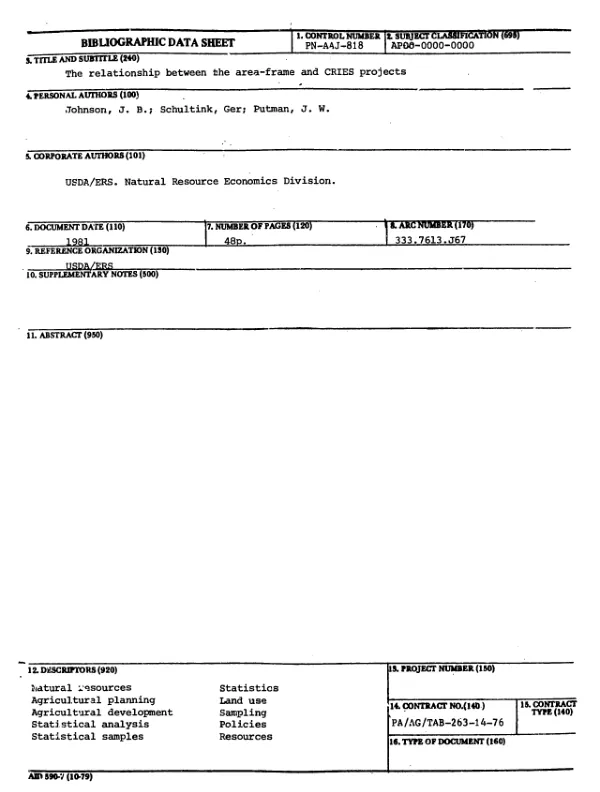
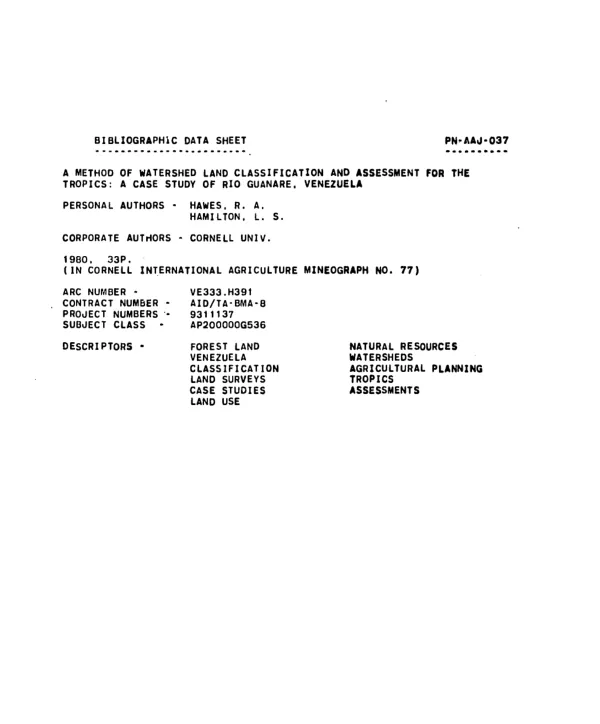
METHOD OF WATERSHED LAND CLASSIFICATION AND ASSESSMENT FOR THE TROPICS : A CASE STUDY OF RIO GUANARE, VENEZUELA
Sign inCORNELL UNIVERSITY
METHOD OF WATERSHED LAND CLASSIFICATION AND ASSESSMENT FOR THE TROPICS : A CASE STUDY OF RIO GUANARE, VENEZUELA
To avoid environmental degradation while developing natural resources in the tropics, an adequate appraisal of existing land resources is prerequisite.
HAWES, ROBERT A.; HAMILTON, LAWRENCE S. · 1970
Sign in to readA free account is required to download.
Abstract
Adequate appraisal -- which must be simple, flexible, technically sound, and quickly executed -- involves assessing an area"s major environmental components, delineating relatively homogeneous environmental units which tend to respond uniformly to a given treatment, and describing local prevailing or likely land use practices. This report describes the methodology used in an appraisal, carried out largely by one person over a 20-month period, of the 157,000 ha of Venezuela"s Rio Guanare region. To provide a framework for assessing biotic performance capabilities, Rio Guanare"s upper and middle watershed area of plains, piedmont, and bedrock-controlled mountains was divided into five tropical forest bioclimate zones: (1) dry, cleared for cultivation or grazing; (2) moist, cleared for permanent agriculture; (3) premontane moist, cleared for permanent agriculture or burnt for grazing; (4) premontane wet, with a diverse vegetative cover; and (5) lower montane wet, a mixture of forest and grassland. To determine broad land zones, this framework was applied to geological materials taken from maps, aerial photographs, and field studies. The resultant 46 land types were rated for their present suitability for the production of five crop types (coffee, bananas, maize, citrus, and cassava), grazing, watershed protection, and the production of timber, firewood, or commercial forests. The five ratings (from highly suitable to permanently unsuitable) correspond to those of the Food and Agriculture Organization. In contrast to earlier, more pessimistic area studies, about 36% of the land was rated as being high to moderately suitable for some type of agriculture, mainly coffee production. Included in forestry-related findings were that 16% of the watershed is in critical condition and should remain forest and that only 10% of the area is suitable for fuelwood production. Areas and species permanently non-suitable for various activities are specified and the need to account for such non-suitability in planning is stressed. Appendices include a 21-item Spanish and English bibliography (1958-80).
Related documents