U.S. DEPT. OF AGRICULTURE. ECONOMIC RESEARCH SERVICE
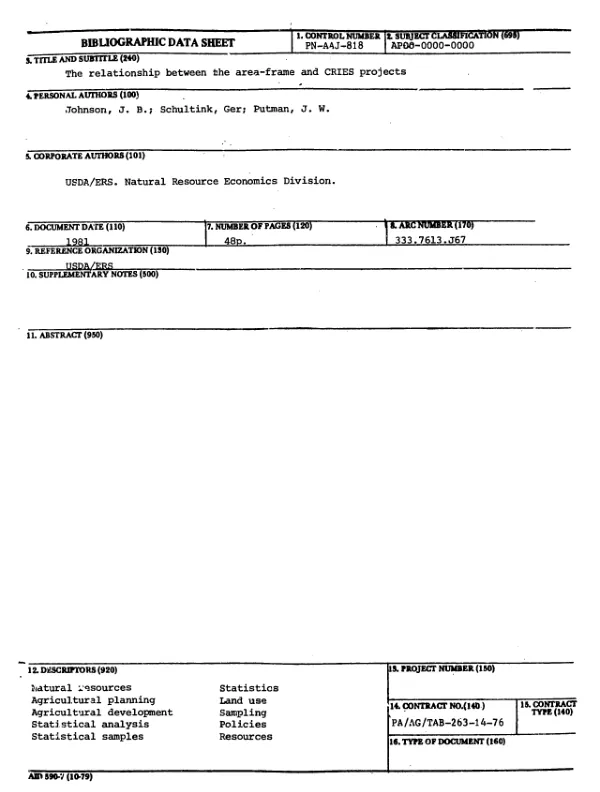
RELATIONSHIP BETWEEN THE AREA - FRAME AND CRIES PROJECTS
Diverse and separately pursued methods are preventing A.I.D."s Comprehensive Resource Inventory and Evaluation (CRIES) and Area-Frame (AF) projects from achieving their common aim of helping developing country planners better assess their countries" land potential.
JOHNSON, J. B.; SCHULTINK, GER +1 more · 1970
Sign in to readA free account is required to download.
Abstract
To correct this situation, this report compares the two projects and recommends their integration. The CRIES project classifies a country"s natural resources (NR) into Resource Planning Units (RPU) and relates land use and agricultural performance data to these units to lay a basis for analyzing policy alternatives. The AF project, on the other hand, expands enumerated data from small and random sample areas to national or subnational levels, providing a statistically reliable account of agricultural performance variables. Both projects employ land use data, including aerial photography and LANDSAT imagery data, as well as medium-scale topographic maps. The CRIES project uses maps on soils, climate, surface and groundwater, etc., to delineate RPU"s; while AF projects traditionally use such data -- by means of physical overlay procedures -- only to verify the land use patterns used for stratification. Nevertheless, AF projects sometimes computerize the mapped data, while CRIES often uses physical overlay procedures to delineate RPU"s, and both projects usually employ computerized information systems. The following recommendations are made for integrating the projects where they are to be implemented concurrently: (1) Both projects should determine country data needs and capabilities, select one topographic base suitable to each and a single geographically-referenced information management system (with one project including topographic/political boundary mapped data), and select classification criteria for a major land use map (with one project interpreting aerial data for the map). (2) CRIES should conduct and evaluate NR inventories and provide AF"s with copies of these maps; have AF statisticians provide primary data for CRIES baseline data sets; and provide training in NR data collection, evaluation, and management and, together with AF personnel, in agricultural policy planning techniques. (3) AF should proceed with frame construction and training in project procedures.
![Vision for [Egyptian] agriculture](https://covers.devme.ai/gen/64061.webp)