INTERNATIONAL RICE RESEARCH INSTITUTE (IRRI)
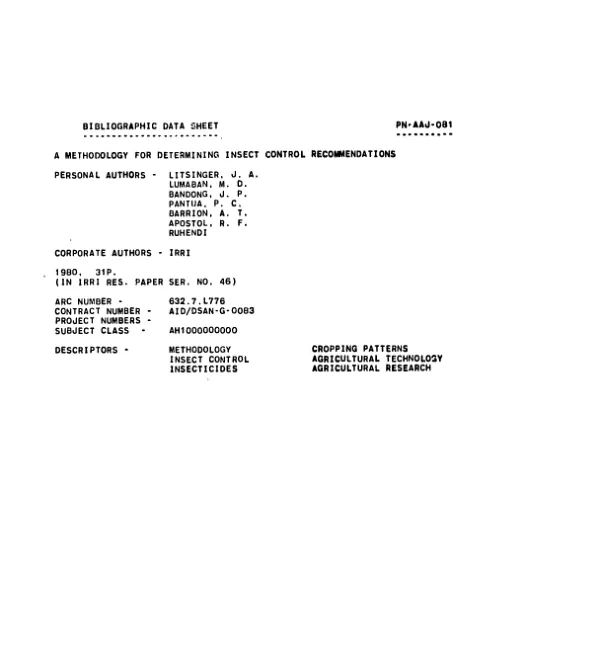
Methodology for determining insect control recommendations
A cropping systems approach has recently emerged as an effective means of improving insect control - a task which, because of its complexity, high demand on resources, and location-specific nature, has impeded past efforts to produce on-farm yields comparable to those obtained at research stations.
Litsinger, J. A.; Lumaban, M. D. · 1970
Sign in to readA free account is required to download.
Abstract
This report explains the role of cropping systems research in insect pest control and outlines a methodology for determining insect control recommendations. Cropping systems research entails specifying a given insect pest control technology by taking into account the cropping patterns of individual farmers, the geographical and temporal distribution of pests, environmental parameters (e.g., rainfall, soil type, landform), cultural practices (e.g., planting, irrigation, and insecticide application methods), farmers" capabilities (e.g., resources, beliefs, and customs), and a crop"s inherent yield potential. A four-part methodology for using cropping systems data, developed in accordance with the requirements of the Asian Cropping Systems Network of research sites, is presented. The initial stage, description, entails gathering baseline economic and biological data on pests known to farmers, the level of pest control needed, the current status of insect control, and the kinds and levels of technology farmers are willing to adopt. Next, several tentative insect control technology packages compatible with farmers" resources and capabilities are designed. These packages consist of specific insect pest control recommendations - i.e., lists of insects and the insecticides effective against them, resistant varieties, and cultural control methods - pertaining to the entire spectrum of pest problems for each crop within the target area. These alternative packages are then tested for several years at each site. Finally, the costs and returns of the alternative packages are evaluated. The above method, in the authors" opinion, will allow the development of optimal insect control recommendations within 2-3 years, is highly objective, is not costly, and can be carried out by researchers with minimal experience. A 21-item bibliography (1976-79) is appended.