ABT ASSOCIATES
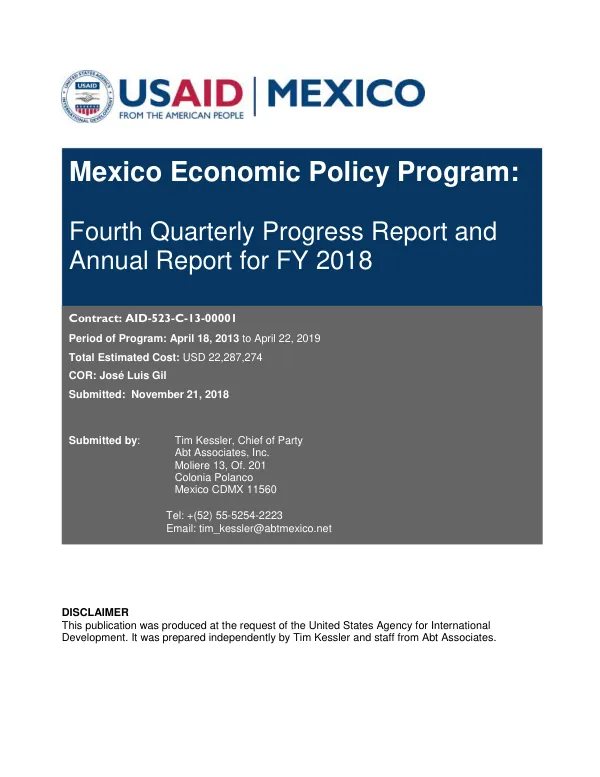
Mexico Economic Policy Program 4th Quarter and Annual Report FY 2018
The Mexico Economic Policy Program (MEPP) has two overarching goals: to improve the transparency of government institutions at the federal and local level, and to strengthen the knowledge and capacity of citizens who seek to hold government accountable for its actions, decisions, and spending.
2018 · 17 pages
Sign in to readA free account is required to download.
Abstract
MEPP carries out most activities in Mexico City, with a small grant supporting a procurement transparency program in Monterrey, Nuevo Leon. The program's activity description includes four main components: civic engagement in open government, local government regulatory transparency for businesses, public procurement reform, and implementation of the National Anti-Corruption System (SNA). Civic engagement involves strengthening the ability of journalists to use open data tools to investigate and report on the use of public sector resources, as well as building and implementing a robust primary education curriculum to create a culture of civic responsibility for public school students. Local government regulatory transparency for businesses involves operationalizing and mainstreaming the National Regulatory Improvement Observatory, which enhances the transparency of state and municipal regulations and creates an opportunity for businesses and civil society actors to exert pressure for regulatory reform. The program also creates and implements a state government interactive electronic platform that enables entrepreneurs to track the status of important applications, such as business licenses, zoning, and construction permits. Public procurement reform involves monitoring new public contracts using the Corruption Risk Index developed during the Option Period, promoting the use of the tool among non-governmental actors, and creating algorithms that select government agencies can use to evaluate the transparency and efficiency of public procurement for specific goods and services. The program also carries out a comprehensive diagnostic of public procurement for a state government, including the creation of an open multi-stakeholder forum to monitor and strengthen the state's contracting processes. Implementation of the National Anti-Corruption System (SNA) involves developing and implementing a comprehensive communications strategy for the Executive Secretariat of the SNA to give academics, civil society organizations, government officials, and journalists accurate and useful information about the system's functions and impact. The program also creates an electronic platform that any state can adapt to disclose information about its intentions and achievements regarding the adoption of SNA laws and institutions. The most important contextual factor for FY 2018 was the July election of Andrés Manuel López Obrador as the next president of Mexico. As his administration will formally begin on December 1, 2018, the months following his election began the political transition process. MEPP is working with current federal government counterparts to prepare findings and recommendations that can be effectively communicated to the transition team. The most important government institutions involved in implementing MEPP-supported governance reforms include the National Regulatory Improvement Commission (Conamer), the Ministry of Public Administration (SFP), and the Executive Secretariat of the National Anti-Corruption System (SESNA). Conamer was the principal government partner in creating the National Regulatory Improvement Observatory, while SFP played a key role in convening and promoting the multi-stakeholder Working Group on Public Purchases (WGPP). SESNA's leadership structure will not be affected by the new administration, and most of the state governors responsible for establishing local anti-corruption institutions will continue in office. Annex 1A presents the indicators for the Extension Period, while Annex 1B presents a full summary of indicators, targets, and achievements for the Option Period. Annex B describes Option Period activities completed by April 2018, and Annex C describes Extension Period activities that continue technical assistance provided during the previous two years. Annex C includes a dedicated narrative of progress achieved during the fourth quarter of FY 2018.