USAID DEC
Microbial degradation of the herbicide atrazine and its 2-hydroxy analog in submerged soils
Sign inUNIVERSITY OF HAWAII AT MANOA
Microbial degradation of the herbicide atrazine and its 2-hydroxy analog in submerged soils
Soil-applied pesticides transported by erosion from the site of application to waters and sediments are subject to conditions sufficently different from those of aerated soils to alter pesticide persistence.
Goswami, K. P.; Green, R. E. · 1970
Sign in to readA free account is required to download.
Abstract
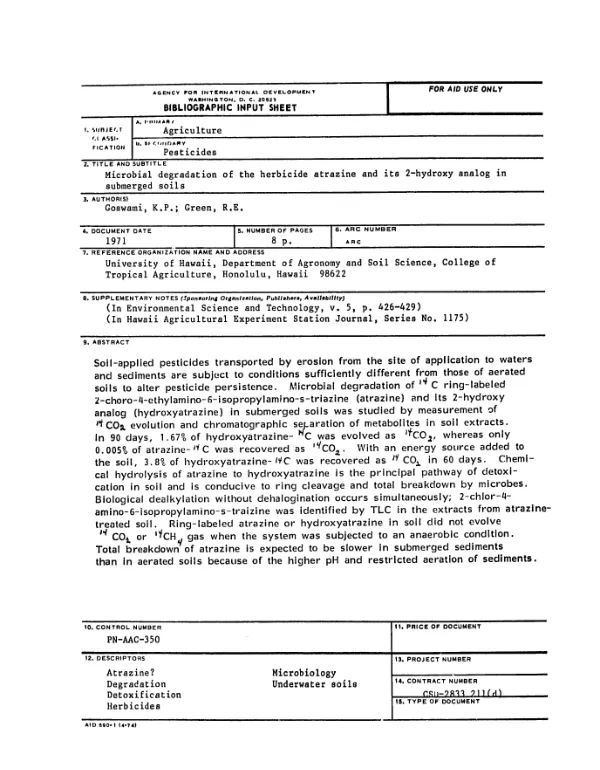
Microbial degradation of 14(C) ring-labeled 2-choro-4-ethylamino-6-isopropylamino-s-triazine (atrazine) and its 2-hydroxy analog (hydroxyatrazine) in submerged soils was studied by measurement of 14(CO2) evolution and chromatographic separation of metabolities in soil extracts. In 90 days, 1.67% of hydroxyatrazine-14(C) was evolved as 14(CO2), whereas only 0.005% of atrazine-14 was recovered as 14(CO2). With an energy source added to the soil, 3.8% of hydroxyatrazine-14C was recovered as 14(CO2) in 60 days. Chemical hydrolysis of atrazine to hydroxyatrazine is the principal pathway of detoxication in soil and is conducive to ring cleavage and total breakdown by microbes. Biological dealkylation without dehalogination occurs simultaneously; 2-chlor-4-amino-6-isopropylamino-s-traizine was identified by TLC in the extracts from atrazine-treated soil. Ring-labeled atrazine or hydroxyatrazine in soil did not evolve 14(CO2) or 14(CH4) gas when the system was subjected to an anaerobic condition. Total breakdown of atrazine is expected to be slower in submerged sediments than in aerated soils because of the higher pH and retricted aeration of sediments.
Connected topics