CREATIVE ASSOCIATES INTERNATIONAL, INC. (CAII)
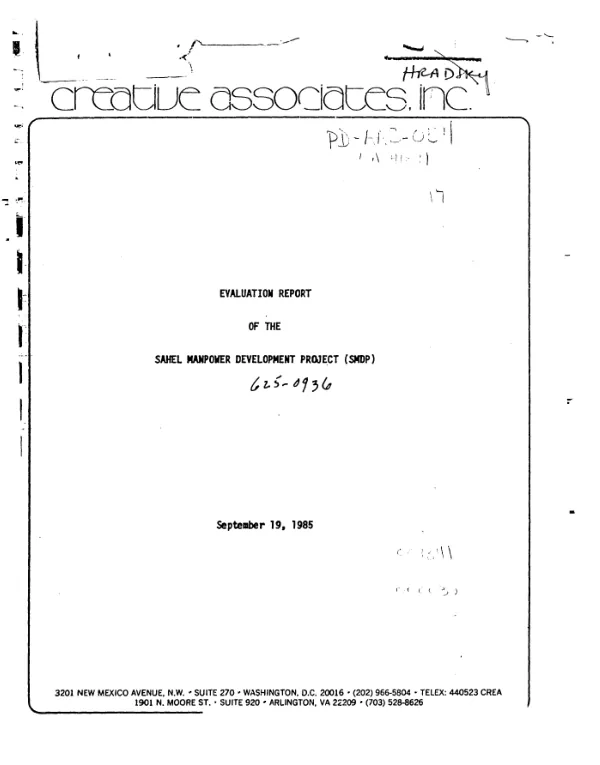
Mid-point evaluation : development leadership training project - Mali 1985
Evaluates project to provide U.S.
Abou-Sayf, Frank K.|Sidibe, Cheick Oumar · 1985
Sign in to readA free account is required to download.
Abstract
training to 60 mid-level Malians who would then return to Mali to take up management positions in private and public institutions. External, mid-point evaluation covers the period 8/81-7/85 and is based on document review, site visits, and interviews with project personnel and beneficiaries. Activities are proceeding smoothly after a shaky start. The initial plan to send three groups of 15, 20, and 25 trainees overseas to obtain Master's degrees in Business and Public Administration, Economics, and Education has been revised to four groups of 15 each. Of these four groups, two have begun U.S. training and a third has begun English language training (ELT) in Mali in preparation for departure. Training activities have been greatly aided by an efficient selection procedure; most participants are of high caliber and are performing well. However, implementation has been weak in several areas. (1) The number of female and private-sector candidates is below planned levels. (2) ELT has been deficient in two areas: speaking and listening comprehension. (3) The orientation program has not sufficiently informed participants about various phases of their program. (4) Procedures for arranging housing for participants upon their arrival is inadequate and has caused some participants considerable anxiety. (5) The project budget has been inappropriately designed; while most expenditures are less than anticipated, participant allocations are insufficient. (6) Finally, the Project Advisory Council (PAC) is flawed and unable to serve the purpose for which it was designed. Colleagues and supervisors of participants conducting field research have reacted poorly to participant's title of "leader" and have not provided adequate cooperation. The project's success has confirmed the idea that Malians are attached to their homeland and return home after graduation, unlike participants of many other nationalities. Another important lesson is that a sound screening process is one of the most important determinants of the success of any participant training project. It is recommended that: (1) expectations for the number of women and private sector participants be lowered and the participants be spread out over more universities; (2) participant allocations be raised; (3) the number of participants in the final group be raised to 20; (4) selection procedures focus on economics majors who now make up a low proportion of total participants; and (5) the PAC be terminated and replaced with a General Advisor and academic experts who could be consulted on theses on an as-needed basis.