ADVENTIST DEVELOPMENT AND RELIEF AGENCY INTERNATIONAL (ADRA)
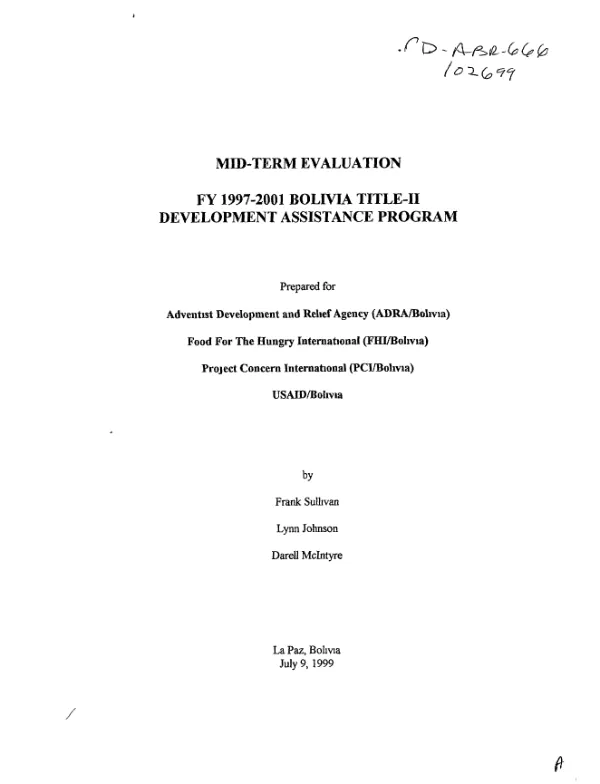
Mid-term evaluation : FY 1997-2001 Bolivia Title II development assistance program
Evaluates the Title II program in Bolivia, being implemented by three Cooperating Sponsors (CSs) -- Adventist Development and Relief Agency (ADRA), Food for the Hungry International (FHI), and Project Concern International (PCI).
Sullivan, Frank|Johnson, Lynn|McIntyre, Darell · 1999
Sign in to readA free account is required to download.
Abstract
The program has four components: maternal and child health (MCH); community water and sanitation (W&S); agricultural production; and food for education (FFE). Interim evaluation covers the period 1997-7/99. In MCH, PCI has developed good collaboration with the Ministry of Health (MOH); PCI also emphasizes the importance of communication in the native language. However, a good information system is not being used by the MOH or the community. FHI has developed an excellent 5-year strategy, coupled with a sound community education program, but budget cuts have adversely affected its MCH program. ADRA has a good educational program linking community health workers (CHWs) to the MOH; how these activities will continue after ADRA leaves is unclear. In W&S, PCI has two basic weaknesses, lack of a strategic focus and low budget support. FHI has a strong cadre of water staff and a very good product. ADRA's activities in W&S are small and receive low budget support. All three CSs are successfully promoting village water committees and tariffs. Weaknesses include unfamiliarity with Bolivian norms of rural water system construction and lack of attention to sustainability. In summary, FHI is delivering a high quality product. PCI and ADRA need to dedicate more budget, staff, and longer presence in the community to improve their W&S portfolios. In agriculture, a major strength of PCI is its institutional collaboration; a weakness is operation and maintenance of irrigation systems. FHI's greatest strength is a five-phase approach to activities and strong technical staff. However, FHI appears to be relatively less disposed to collaborate with other institutions. One ADRA strength is a solid basis in community plans; another is food-for-work activities; infrastructure is a weak area. All three CSs are weak in marketing. In summary, the agricultural program is basically sound. Approaches differ, but all the CSs address the root causes of food insecurity. In FFE, there are not many program differences. Warehouse management and food distribution take place smoothly and there were numerous comments that the ration could be increased. The environmental damage of cooking the ration with firewood in tree-scarce Bolivia could be considerable. Some schools serve the "breakfast" at 11:30 with good results. In almost every school, some negative factor is affecting girls' enrollment; until now, the CSs have not directed attention to this issue. In summary, the FFE component is accomplishing its goals: overall, girls' enrollment and retention are up, and the school dropout rate is down for both sexes. Promulgation of the Law of Public Participation has given the CSs more opportunity to interact with municipal authorities; good coordination, interchange, and financial support are being achieved. All CSs are working to foster community participation and linkages with local institutions. Environmental awareness is growing in each of the CSs. In terms of program management, it is recommended that senior leadership of each CS travel more frequently to the field and that each CS hire an organizational development consultant to deal with issues of rapid portfolio expansion. Staff morale, work performance, and "burn out" are issues in several CSs, as are decentralization, discipline, internal communication, human resource management, monetization, and Call Forwards. The Bolivia Title II program is achieving many of its objectives; concentrating resources in areas of greatest poverty has brought significant improvements in program impact. The originally envisaged synergy between health, water, agriculture and education is achieving important goals. An indirect outcome of the mid-term evaluation has been a sharing among CSs rarely achieved in Bolivia. The evaluators were also impressed with the Mission's ability to focus on key management issues while not interfering with the day-to-day operations of the CSs. This relationship between partners has not been widely seen in Latin America.