ECCLES ASSOCIATES
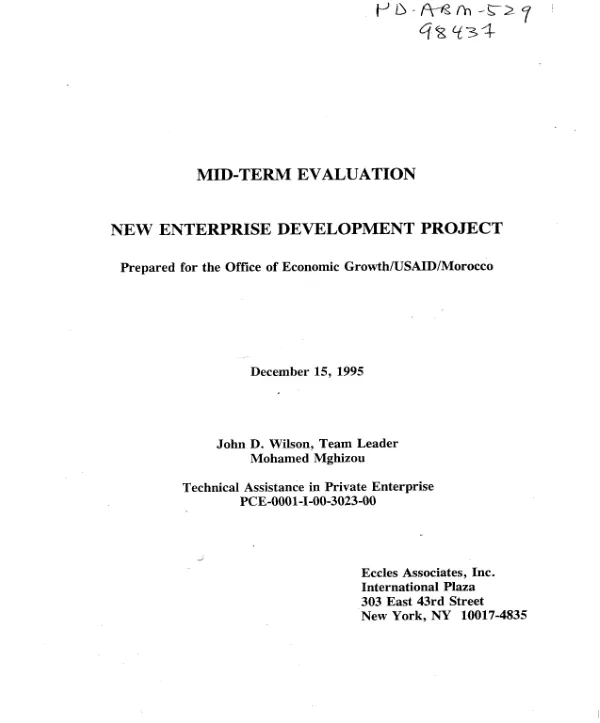
Mid-term evaluation : new enterprise development project
Evaluates project to strengthen small and medium-scale enterprises (SMEs) in Morocco through organizational and administrative reform, access to credit, and business advisory services.
Wilson, John D.|Mghizou, Mohamed · 1995
Sign in to readA free account is required to download.
Abstract
Mid-term evaluation covers the period 10/92-11/95. After 3 years of activity there are some successes, but they are more qualitative than quantitative. The reform component has achieved some concrete results and initiated promising grant activities, yet there has been no Government of Morocco (GOM) response to the project's reports recommending reform, and there is no assurance that it will respond, despite the private sector's interest in reforms. The grants to 13 SME associations seemed to have helped unite the SME community around issues of shared interest, but the full impact of these grants is difficult to assess. The computerization of the Registre Central du Commerce is a groundbreaking accomplishment. Despite the mixed record to date, implementation of this component is being vigorously pursued and it is expected that results will be more fully realized within the next several months. In the business advisory component, the Centre de l'Enterprise due Maroc (CEM) has struggled to establish itself and determine where its focus should be and how it should be structured, but CEM has been able to meet few of its numerical goals; nor is it likely to achieve financial self-sustainability. CEM's problems seem to stem from (1) a deeply flawed project design that ignored cultural considerations and imposed unrealistic objectives which required/encouraged an elaborate physical infrastructure and a budget and staff inappropriate for the task assigned; (2) use of a cooperative agreement (CA) as the procurement instrument which denied USAID the necessary control over CEM's operations; (3) the limited experience of Ecole Superiere de Gestion (ESG), the CA recipient, with the SME sector despite its claim to posses such experience; and (4) a lack of understanding by USAID and ESG of how an entity such as CEM should have been structured, and what results it could be expected to produce. The CA should be terminated as quickly as possible. The proposed credit facility was never established, for reasons beyond USAID's control. Its loss has been much lamented, although in light of CEM's difficulties, the decision not to fund the facility may have been inadvertently fortunate. A pilot program, Credit Wassila (CW), has been introduced but made no credit awards to date. CW's design is questionable in that CEM -- with a vested interest in having its clients obtain credit -- was designated to be the decision maker with Banque Centrale Populaire expected to provide virtually automatic approval of those candidates CEM proposed for credit. In the absence of CEM or a similar USAID program for business support services, the component should be discontinued. The following lessons were learned. (1) USAID should have obtained the GOM's firm support for all the project's objectives, and sensitized all parties with whom it worked as to the potential far-reaching impact of successful organizational and administrative reform. (2) Avoid allocating funds only because they will be returned to Washington if they are not used. (3) Avoid entering sectors in which so little is known. There were not sufficient grounds for committing to a $25 million effort with SMEs. One effective way to avoid entering areas where there is unsatisfactory information is to move the project forward in stages. For example, at least three small CEM centers could have been started in different cities with the funds that were committed to one large center. (4) Avoid projects that involve risk if one is not prepared to take a risk. (5) Avoid using CAs for projects over which USAID wishes to exercise reasonable control. (6) Avoid unrealistic projects. It was estimated that 20-50 people would visit CEM each day, with an equal number of other contacts. During a 3 years, only 5,000 contacts were made, vs. a target of 22,000-52,000. (7) Be willing to cut losses early in a project, if warranted. (8) Avoid inconsistencies between and within contracts and other procurement instruments. For example, the CA has numerous contradictions regarding its goals and what was to be accomplished within a given time period. (9) Avoid the term "self-sustaining" when the real goal is for an activity to become "self-perpetuating".