USAID DEC
Mid-term evaluation of agricultural development : research and extension project (611-0211) (Zamare)
Sign inUSAID. MISSION TO ZAMBIA
Mid-term evaluation of agricultural development : research and extension project (611-0211) (Zamare)
Evaluates project to strengthen the Government of Zambia's (GOZ's) small farm sector agricultural research and extension services.
Yohe, John|Kellogg, Earl · 1984
Sign in to readA free account is required to download.
Abstract
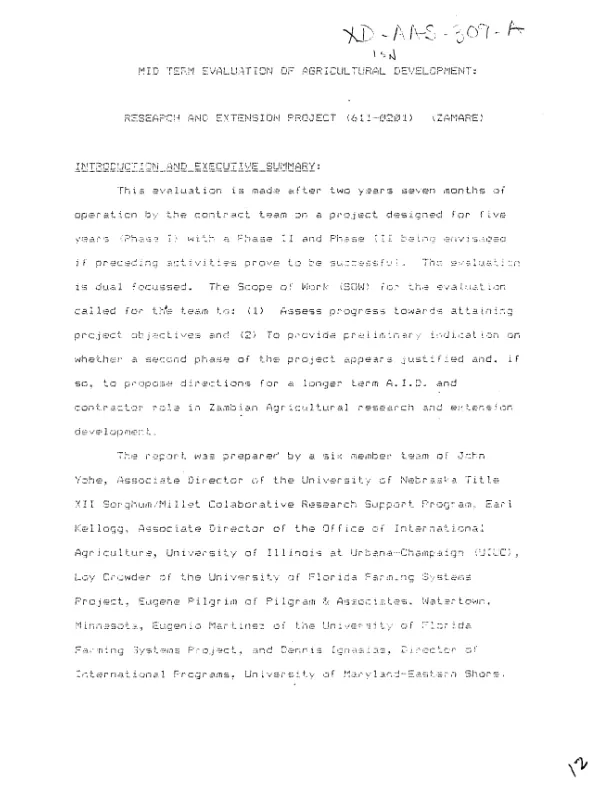
Mid-term (10/83-3/85) outside evaluation is based on document review and extensive interviews. The project has made excellent progress in supporting the G0Z's agricultural research and extension (R/E) program - the unplanned success of which has, in fact, posed logistic problems (which are, however, resolved as they occur). The project's commodity research teams (CRT's) have developed two new early-maturing maize varieties with high yield potential and disease tolerance, which will be used on-farm in 1985/86, and 2 free-nodulating soybean varieties, which have prompted the planting of soybeans on small farms. The soil microbiologist purified the local inoculum and introduced 2 more efficient indigenous strains, and it is expected that Zaire will be self-sufficient in inoculum for 1985/86. Some strains of sunflowers with higher - up to 40% - oil content have been identified, but seed demand has been low; major constraints to the mostly small-farm production of sunflowers have been agronomic practices. The Adaptive Research Planning Teams (ARPT) concept has been very successful in bridging the gap between the CRT's and adaptive farming systems R/E. ARPT's are operational in several provinces, and the Research Extension Liaison Officer (RELO) in Central Province has shown the concept to be viable for linking commodity research and R/E (so successful that the design team has recommended allowing extension specialists to work more closely with other ARPT members on a regular basis). While extension has not yet been emphasized, all project staff have been involved in some manner. Successful implementation is in part due to well-qualified project staff and their outstanding success in working with Ministry of Agriculture and Water Development counterparts. All 34 participants have departed and will complete training during the project; short-term training is on schedule and has been as successful. Recommendations for the remainder of Phase I and for Phase II are provided.