USAID. BUR. FOR PROGRAM AND POLICY COORDINATION. CENTER FOR DEVELOPMENT INFORMATION AND EVALUATION (CDIE)
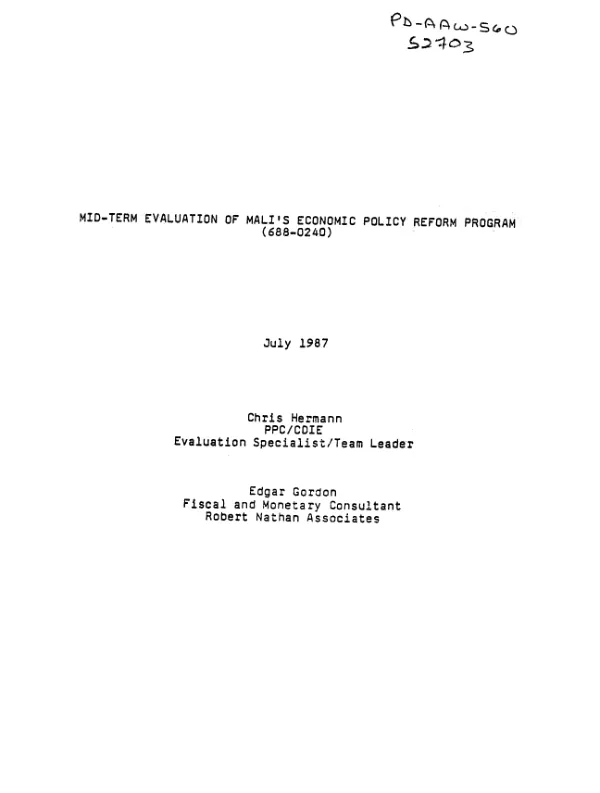
Mid-term evaluation of Mali's economic policy reform program (688-0240)
Evaluates Economic Policy Reform Program (EPRP) to support fiscal, budgetary, and business environment reforms by the Government of Mali (GRM).
Hermann, Chris|Gordon, Edgar · 1987
Sign in to readA free account is required to download.
Abstract
Midterm evaluation covers the period 9/85-7/87; methodology is not stated. Considerable progress has been made on virtually all targeted reforms during the first 20 months of the program, and three of five tranches, amounting to $10.115 million of the $16.7 million available, have been released. The following reform measures are among those enacted: a halving of the payroll tax rate; a 5% reduction in maximum business taxes and a 25% reduction in minimum profits tax; an average increase of 17% in administratively determined customs valuations; price decontrol of selected consumer items; enactment of a new Commercial Code; complete computerization of the payroll; a substantial reduction in civil service hiring; and planning and start-up of a voluntary early departure program (VED) for civil servants. Although it is too early to assess the program's economic impact, progress to date demonstrates the GRM's commitment to policy reform. One area where progress has not been made is in initiating a plan to privatize state enterprises; however, there has been a positive change in the GRM's perspective on the role of the private sector (as seen by its willingness to enact tax cuts, despite the economic difficulties it faces) and there is sufficient time remaining in the EPRP for the GRM to comply with the privatization condition. Progress has also been very limited in the area of improving administrative efficiency. The recent decline in the value of the dollar has led to a misunderstanding on the part of the GRM over whether funding levels are specified in CFA francs or dollars (the latter is in fact the case). This should be clarified. If EPRP is representative of economic policy reform programs, then these programs are not a means of reducing management requirements for A.I.D. The program has been far more staff intensive than expected, even though USAID/M's management has been responsive and competent, excellent support has been provided by the Ministry of Finance and Commerce, and TA has been sound. Recommendations are, inter alia, to: continue to make privatization planning a condition for disbursement; conduct a thorough study of the first group of VED participants and consider reprogramming funds the program is performing poorly; conduct other studies on means of private sector development; and support further reforms of tax and customs systems and further improvements in MFC information systems.
Related documents