USAID DEC
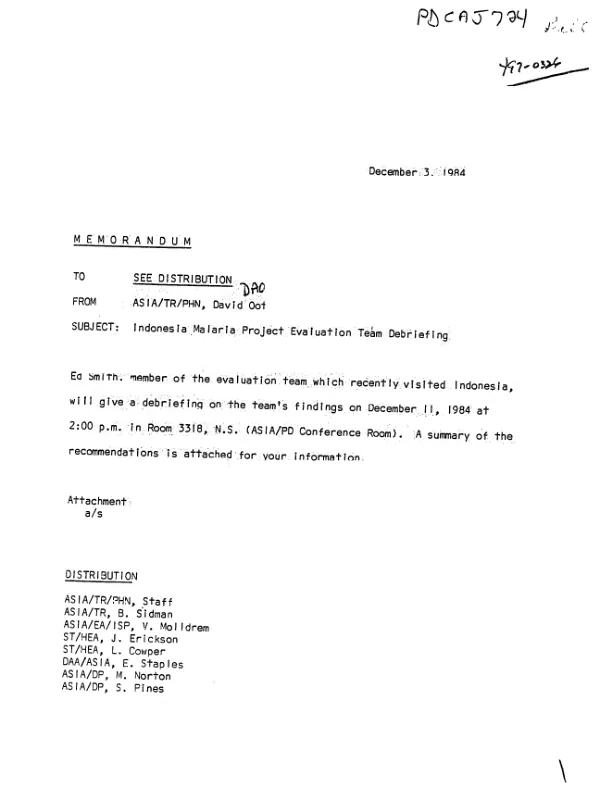
Mid-term evaluation of Timor malaria control programme, October-November 1984 : executive summary
Sign inUSAID. MISSION TO INDONESIA
Mid-term evaluation of Timor malaria control programme, October-November 1984 : executive summary
Evaluates malaria control project in Timor Island, Indonesia.
Smith, Ed · 1984
Sign in to readA free account is required to download.
Abstract
Special evaluation covers the period through 12/84; no methodology is given. While the project"s house spraying operations have drastically reduced the incidence of malaria in Timor, several problems (most importantly, financial and personnel constraints) must be addressed. Delays in release of project funds (due to late and improper document preparation) have postponed malariometric surveys and spraying operations planned for Sept./Oct. 1984; the latter will not get underway until well after the start of the rainy season. Equally serious are personnel constraints - especially the difficulty of recruiting, training, and retaining local personnel in East Timor. Without local personnel, Timor will have no prospects for achieving a self-sustaining malaria control program. Furthermore, recruitment of experienced temporary personnel from Java and Bali has been impeded by a decision to restrict per diems to 14 days, when 30 days would be minimum to be cost effective. Personnel problems have also resulted in the lack of entomological data collection in East Timor and very little (limited species and density surveys) in West Timor. No M.Sc. medical entomologist is currently assigned to either province. Three assistant entomologists were trained in East Timor, but those positions are now vacant. Two assistant entomologists in West Timor require refresher training and administrative assistance to carry out entomological studies. Also, a shortage of and/or misuse of vehicles has hampered field operations. With the project 80% completed, only half of the $140,000 set aside for vehicles has been spent. Specific recommendations are provided for coping with these constraints, as well as recommendations aimed at: upgrading the quality of examination of malaria slides; developing an overall training plan for both provinces; and assigning an experienced malariologist to provide TA, especially in the area of training. It is also suggested that the project be extended 2 to 3 years, with its goals and objectives revised in light of performance to date.
Related documents