USAID. MISSION TO CHAD
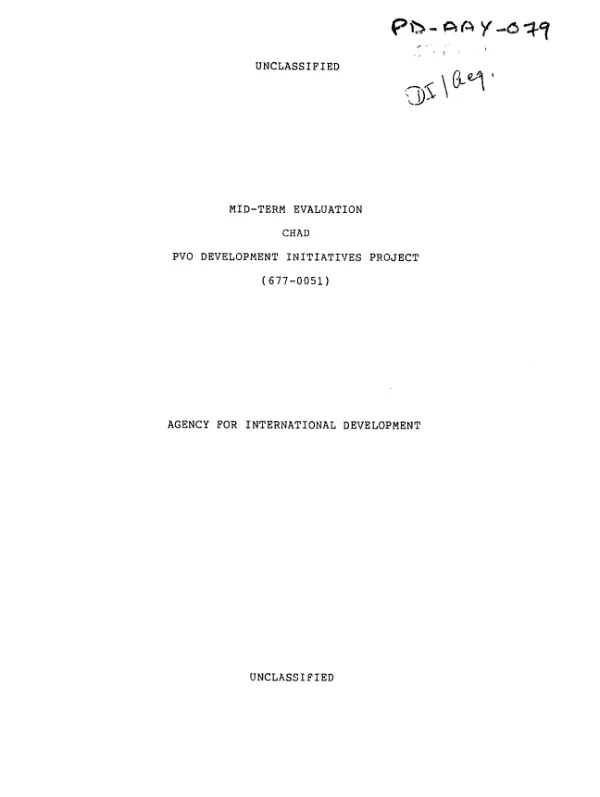
Mid-term evaluation : USAID/Chad PVO development initiatives project
Evaluates project to improve small farmer food production in the Sahelian zone of Chad through four subprojects (SP"s) implemented by four PVO"s (CARE, Africare, VITA, and the Organization for Rehabilitation through Training - ORT).
1988
Sign in to readA free account is required to download.
Abstract
Evaluation covers 6/85-5/88. The project has made progress in irrigated agriculture, water management, farmer training, and, to a lesser extent, private enterprise promotion. Africare has developed two promising water management technologies - the construction of water catchments across wadi beds and an animal traction waterlifting system - for use in the drought stricken Ouaddai prefecture. ORT has developed new tubewell technologies, and CARE has developed improved canal lining techniques to maximize water use efficiency. The project has also had success testing a variety of experimental crops and farming practices. Agroforesty activities have had a mixed record. Fruit tree production and nursery development have been the most successful areas, dune stabilization the least. Tree planting has been hampered by poor conditions (e.g., lack of water) and cultural factors (in some areas tree ownership has significant land tenure implications). Credit for farm improvements has had limited effectiveness due to local markets" inability to supply inputs and absorb farm outputs. VITA"s private enterprise credit program is in serious trouble; a new effort to develop export markets for agricultural products shows much more promise. A number of recommendations are made for the project as a whole and for individual SP"s. Clearly the PVO"s should continue to expand their collaboration with each other. However, certain aspects of the project are overextended geographically, and the project needs to reevaluate those areas of Chad that can most benefit from project activities. Food production activities should be concentrated along the Logone and Chari Rivers, and commercial agricultural production should be encouraged in high potential Sahelian/Saharan environments (e.g., the Bahr-el-Ghazal). Finally, forestry activities are best left to forestry-specific projects. The project teaches many vital lessons. While PVO umbrella projects are a valuable development mechanism, it does require time for PVO"s to develop acceptable SP designs. SP"s should focus on doing a limited number of things right, rather than engaging in a broad range of (possibly) superfluous activities. PVO"s with experience working in a given country will usually produce the best results, but prior success in a given activity (e.g., VITA"s previous success with credit programs in Chad) will not guarantee continued success. Finally, the transition from prolonged disaster relief to development activities, as is the case with this project, can be difficult.