U.S. DEPT. OF HEALTH AND HUMAN SERVICES. PUBLIC HEALTH SERVICE. OFC. OF INTERNATIONAL HEALTH
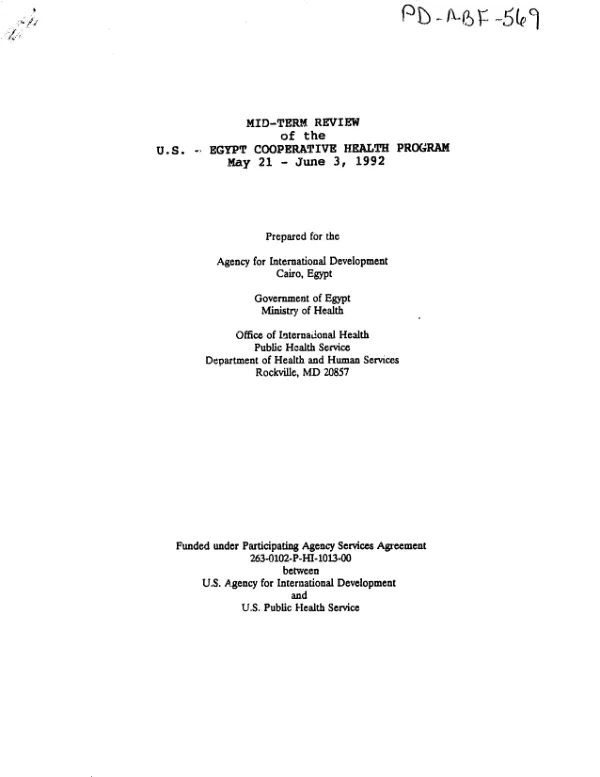
Mid-term review of the US-Egypt cooperative health program : May 21-June 3, 1992
Evaluates the U.S.-Egyptian Cooperative Health Program, which consists of 17 health projects conducted in partnership between Egypt"s Ministry of Health (MOH) and three U.S.
1992
Sign in to readA free account is required to download.
Abstract
public health agencies: the Centers for Disease Control (CDC), the Food and Drug Administration (FDA), and the National Institutes of Health. Midterm evaluation covers the period 12/90-6/92. Due to the Gulf War, the program did not really get underway until the second half of the first year. Nonetheless, with few exceptions the projects have made substantial progress and most are sustainable. Staff are highly enthusiastic and competent, levels of cooperation between U.S. and Egyptian principal investigators are high, and the Office of International Health (OIH), which is managing the program, and USAID appear to have an excellent relationship in Egypt. Some of the projects (vaccine development, cancer and genetic research, medical equipment repair, food and drugs quality control, and health information systems) built on earlier cooperative efforts. Others are new projects, including activities concerning rheumatic fever, filariasis, arboviruses in children, diabetes, hypertension, injury control, and sexually transmitted diseases, as well as feasibility studies for an Egyptian Center for Disease Control and National Library of Medicine System. The projects are progressing well both as individual activities and as an umbrella program. As individual efforts, the projects" abilities to combine the provision of services (such as genetic counseling) with research are of special note. Even when such linkages do not yet exist, the projects are gathering the raw data needed by health planners in designing scientifically sound interventions. As a whole, the projects are providing numerous benefits to the U.S. agencies as well as to Egyptian counterparts, e.g., experience gained in Egypt can be applied to FDA"s efforts to harmonize pharmaceutical regulations as part of the GATT (General Agreement on Trade and Tariffs). The projects are also making an important, coordinated contribution to improving the health and quality of life of the Egyptian population. In fact, such a rich mix of diverse projects in multiple organizational settings may have a greater impact on the MOH"s institutional aims and processes than would any single vertical project of equivalent funding. Continued funding is strongly recommended.