USAID DEC
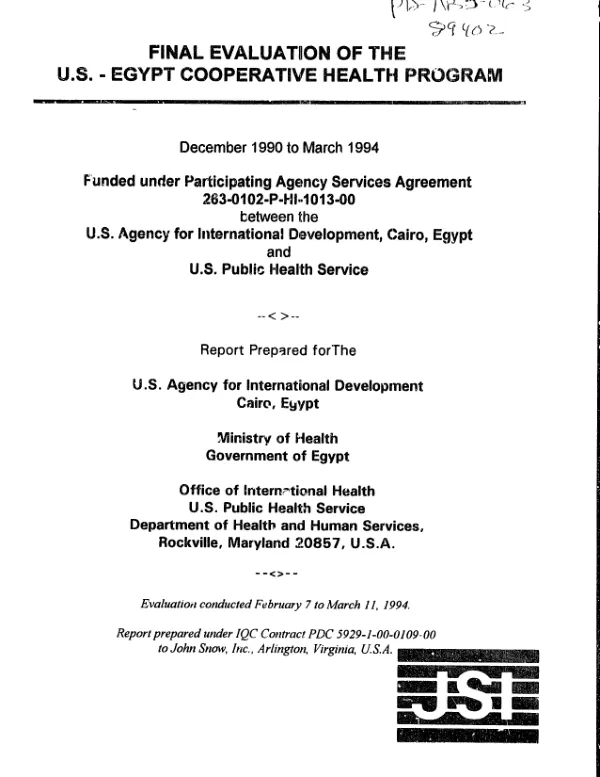
Final evaluation of the US-Egypt cooperative health program December 1990 to March 1994
Sign inJOHN SNOW, INC. (JSI)
Final evaluation of the US-Egypt cooperative health program December 1990 to March 1994
Final evaluation of the Cooperative Health Program (12/90-3/94), which provides TA, through a PASA with the U.S.
Basch, Paul F.|Hammamy, Diaa · 1994
Sign in to readA free account is required to download.
Abstract
Public Health Service (USPHS), to Egyptian researchers. In general, collaboration among USAID, the USPHS, and the Egyptian Ministry of Health (MOH) was quite successful, and the collaborative work of U.S. and Egyptian investigators generated significant research results that could improve health in Egypt. TA was of very high quality. There were many individual achievements. Laboratories and offices in the MOH and universities have been upgraded through equipment purchases; several can now serve as reference laboratories in Egypt and for the region. The capacities of research groups have been greatly enhanced; most received computers and data management training, and several groups gained the capacity to evaluate potential health problems through community prevalence surveys. In service and production-oriented projects, protocols and Standard Operating Procedures were standardized among collaborating institutions and brought up to international norms. Despite these individual achievements, the sustainability of the program and its impact on public health is questionable. At the most basic level, the program simply wasn't long enough to establish a widespread increase in capacity, nor to ensure the sustainability of many of the projects; several investigators expressed apprehension that the equipment and expertise gained may not be usefully employed in the near future. The program also suffered considerable management and logistical deficiencies, especially in the earlier stages, although USAID, by requiring the establishment of an in-country Management Support Unit, was able to resolve many of the logistical issues. On a broader level, the program seemed to lack purpose and cohesiveness. For example, the 17 projects in the program portfolio lacked a common theme, and the translation of research findings into policy was limited. Most this has to be blamed on USAID, which failed to provide adequate direction and oversight, and on the design of the program, which did not establish clear goals or lines of responsibility between the U.S. Office of International Health (OIH), which was responsible for managing the project, and USAID; in fact, there was significant disagreement between USAID and OIH about the nature of the program. The MOH seemed to be left "out of loop" in many cases, and as a result did not feel a sense of ownership of research findings, nor seem very motivated to translate findings into policy recommendations. Future collaborations of this type should include a formal project paper, link program components more closely to current MOH and USAID strategies and goals, focus TA more clearly on sustainability goals, and specify terms of reference and expectations for both USAID and OIH.