EDUCATION DEVELOPMENT CENTER, INC. (EDC) INTERNATIONAL PROGRAMS
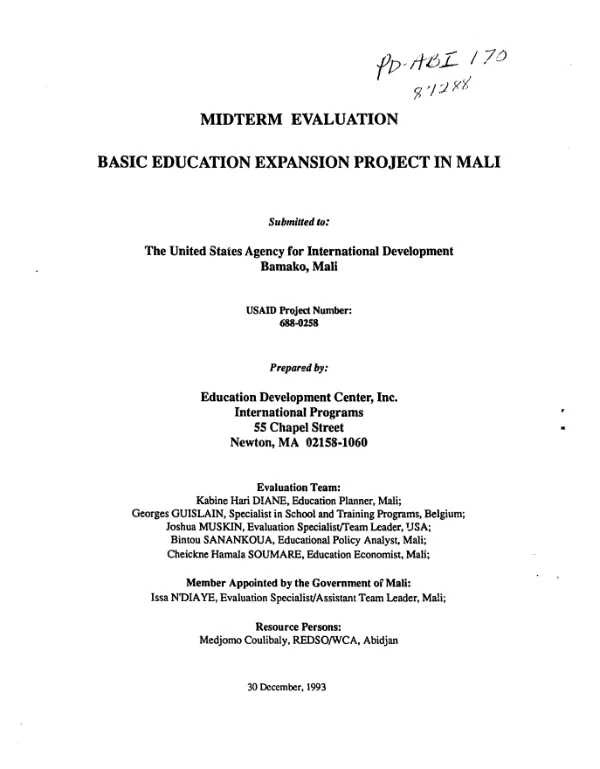
Midterm evaluation : basic education expansion project in Mali
Evaluates program/project to improve primary education in Mali.
Diane, Kabine Hari|Guislain, Georges · 1993
Sign in to readA free account is required to download.
Abstract
Mid-term evaluation covers the period 8/89-12/93. The project has contributed positively to primary education in Mali in many ways, including basic in-service training of nearly 7,000 primary school teachers and all regional directors and inspectors; renovation of more than 400 classrooms; increased girls' participation rates in the project's zone of intervention; improved collecting, processing, and analysis of basic school data; institution of a standardized national testing capacity and broader monitoring and evaluation competencies; nationwide distribution of reading texts for grades one and two; and overall planning and management improvement in targeted divisions of the Ministry of Education (MOE). Despite these considerable successes, it is difficult to conclude that the project has had a systemic or lasting impact on schooling in Mali. This is due in part to design and implementation flaws, but more to contextual circumstances, associated with the start-up and USAID's management and with the social and political changes and turmoil experienced by Mali over the past 3 years. Moreover, 4 years of implementation are hardly enough to resolve a problem as entrenched and pervasive as that of education in Mali. The challenge now is to exploit the strengths of the project so as to ensure their further evolution and lasting nature. The project has shown that if sufficient resources and quality technical support are provided, dedicated, qualified personnel within the Ministry will respond. But how does this process of improvement continue without the sort of resources ($20 million) provided by the project? Neither the monitoring and evaluation, the in-service training, nor the girls' schooling activities will be able to maintain even close to their present levels of activity without continued donor support. Project experience has indicated that the following factors inhibited achievement of the project's purpose: (1) design of the project as a discrete set of strategies (modeled after the World Bank's Fourth Education Project) rather than a systemic approach; (2) constrained communication and cooperation between USAID and the MOE, as well between different units within the MOE and even to a degree between different components of the project -- a situation exacerbated by the changing roster of MOE officials; (3) inability to move beyond rhetoric to implementation in achieving USAID's and the Ministry's regionalization objective; (4) apparent disjuncture between the project and the MOE's education reform objectives, and a lack of strong MOE involvement in the project, a situation again exacerbated by changes in key officials and the country's volatile sociopolitical context; and (5) USAID's focus on its part of the World Bank Fourth Education Project, rather than on a broader systemic national education reform strategy articulated by the government.