AG INTERNATIONAL CONSULTING CORP.
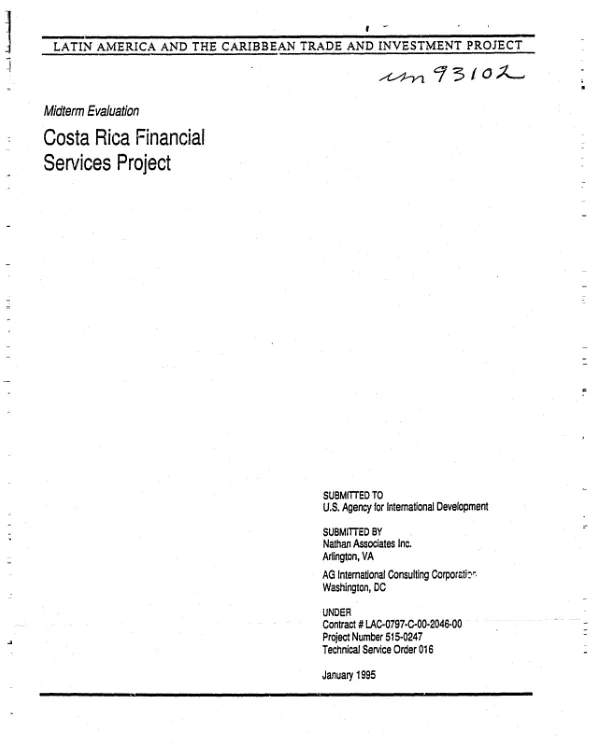
Midterm evaluation : Costa Rica financial services project
Evaluates project to provide secure and efficient financial intermediaries to small and medium-scale savers and borrowers in Costa Rica.
Rourk, Phillip W.|Gomez, Gustavo A.|Hooker, Hilario A. · 1994
Sign in to readA free account is required to download.
Abstract
Mid-term evaluation covers the period 6/90-10/94. Due to delays in negotiating a grant agreement with the Government of Costa Rica (GOCR), implementation did not begin until mid-1991. Productivity in the economic policy analysis and reform component has been high and outputs are generally of excellent quality. Inputs have included directed research, training, and TA. Results have been disseminated through published books and articles that have effectively reached public and private sector leaders and the public at large, as well as through seminars and conferences. As a result of these efforts, the policy and regulatory environment in the financial sector has been improved, mainly through Central Bank administrative actions. Significant progress has also been made on the legislative front, with the preparation of a new draft Central Bank Law. Good relations have been developed with Central Bank leadership, which has expressed interest in continuing project involvement in financial sector reform. The credit union supervision and system development component has made reasonable progress on institutional development but is yet to demonstrate tangible impacts on credit unions' financial intermediation efficiency. Progress has been made towards improving the financial solvency of the credit unions and public confidence in the credit union system (8 of the 13 credit unions are now financially viable). Membership has increased and savings deposits have expanded. Project support also facilitated enactment of a law regulating financial intermediation activities, and establishment of the central liquidity facility. Fedecredito, the key implementing agency of this component, has demonstrated outstanding leadership in organizing and implementing new financial entities, although there is a danger that excessive concentration of authority at the upper levels of the credit union systems might prove unhealthy. Additionally, there is a need for (1) prudential regulation and supervision measures aimed at reducing potential risks derived from the concentration of net debtors on credit union boards, and (2) innovative prudential regulation to ensure that credit unions function with an adequate base of permanent capital. In the financial management and innovation component, the contractor (Ohio State University) considered it essential to focus initial efforts on strengthening the institutional capability of financial PVOs such as ACORDE, FINCA, and Avance. As a result of this strategy, efforts under this component have largely consisted of TA and training in areas such as management capabilities, strategic plans, internal procedures and controls, and portfolio management, with less attention to planned innovative activities. Lessons learned include the following. (1) Costa Rica provides an unusually complete case study of how excessive government control can foster a parallel and dangerous underground financial system. (2) The pace of change in countries with highly developed democratic processes can be excruciatingly slow. (3) A long project development process with piecemeal modifications along the way can result in a loss of coherence. (4) High-level personnel with manifold responsibilities -- in the present project, the Central Bank president -- are not prudent choices for chairing the Project Coordinating Committee.
Related documents
![Evaluation and analysis of AIR [agricultural and industrial reactivation] project](https://covers.devme.ai/gen/6267.webp)