TROPICAL RESEARCH AND DEVELOPMENT, INC.
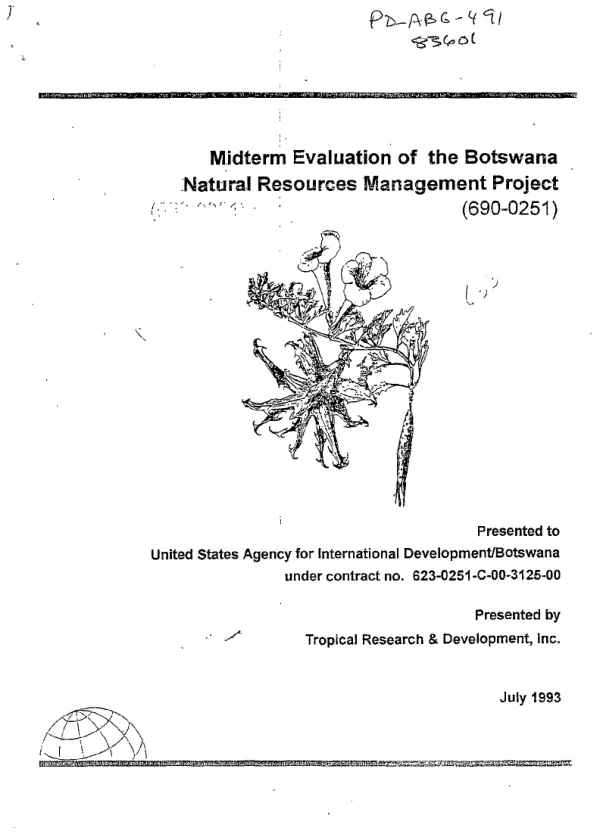
Midterm evaluation of the Botswana natural resources management project (690-0251)
Evaluates Botswana component of a regional project to promote community-based natural resource management and utilization in southern Africa.
Odell, Malcolm J., Jr.|Dickenson, Sally · 1993
Sign in to readA free account is required to download.
Abstract
Midterm evaluation covers the period 8/89-7/93. The project has had to face serious obstacles, particularly a series of flawed assumptions. Contrary to these assumptions, (1) there are few, if any, examples of successful community-based natural resource utilization in southern Africa that can be readily demonstrated and replicated in Botswana; (2) the pool of NGOs with the requisite experience in both conservation and community mobilization is extremely limited; and (3) there is considerable dispute as to whether Botswana actually has sufficient numbers of wild animals to permit community utilization through sustainable harvesting. Perhaps the most glaring flawed assumption was idea that the process could take place within the limited timeframe of a 3-5 year project cycle. Nonetheless, the project is recognized by many both inside and outside the government as an important tool in the Botswana Department of Wildlife and National Parks' (DWNP's) effort to prove itself in the struggle to conserve biodiversity while addressing human needs for economic development. It is also a project that has learned from its mistakes. It has had to overcome the problems of an overly optimistic design and reach consensus within its home department as to what the project is really about. It has operated flexibly and pragmatically, taking advantage of opportunities as they arise, and initiating in different parts of Botswana a variety of activities which have attempted to demonstrate that managing natural resources for sustainable use can be economically valuable to a range of stakeholder groups. Project activities have included: development proposals for community utilization and controlled hunting efforts in several areas; forming a local conservation trust to manage hunting quotas in Chobe Enclave; preparing management plans for Chobe and Moremi Parks; providing technical support for the Nata Sanctuary; and exploring veld product harvesting and marketing potential in eight communities in four districts. Further, the project has assisted the DWNP in undertaking a major staff development program including the establishment of a new extension division and the separation of community mobilization functions from project monitoring and evaluation functions. The project has undertaken a wide range of formal and nonformal education and training initiatives geared toward DWNP staff, schoolchildren, teachers, and the general public. While admirable strides have been made under difficult circumstances, a strengthened and strategic approach is called for; a specific need is to refine the process for assessing the validity of integrated conservation and development models for Botswana. Whether there are two or twenty communities with active management plans by the end of the project is less important than whether the stage has been set for widespread replication in future years. (Author abstract, modified)