DUAL & ASSOCIATES, INC.
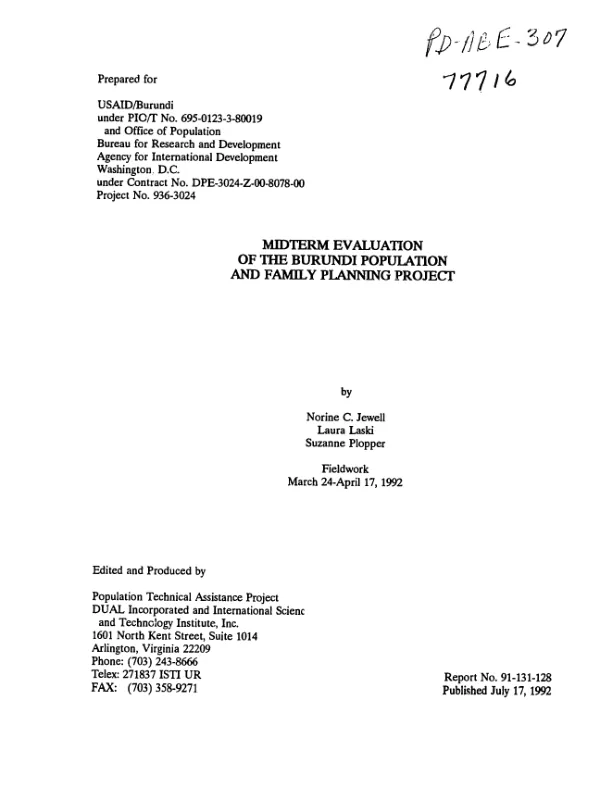
Midterm evaluation of the Burundi population and family planning project
Evaluates project to increase contraceptive prevalence in Burundi.
Jewell, Norine C.|Laski, Laura|Plopper, Suzanne · 1992
Sign in to readA free account is required to download.
Abstract
Midterm evaluation covers the period 10/88-7/92. The project is constrained by a lack of human and material resources. The Ministry of Public Health (MOPH) has not yet provided the professional staff envisioned; USAID/B lacks adequate staff for the project; and a replacement will soon be needed for the resident advisor. Nonetheless, the project is making good progress and benefits from the high level of awareness of population problems shown by both political leaders and the bishops of the Catholic Church. Individual components have fared as follows. (1) A broad range of human resource development and training activities appropriate to program needs have been undertaken. Unfortunately, there is little follow up or supervision of trained personnel. (2) Information, education, and communication (IEC) activities are progressing more slowly but are well-focused. Efforts to date include training of IEC agents and completion of a knowledge, attitude, and practices (KAP) study. The absence of an IEC plan as well as of high-level IEC management expertise in the MOPH is expected to hinder this component. (3) As for service delivery, the logistics, management, and supply system has been strengthened, while the information system is evolving more slowly due to a lack of a management information system specialist; service protocols developed with project assistance have yet to be implemented. Burundi's health care system, which is almost the sole source of FP services, suffers from organizational weaknesses and lack of clear policies, and provides a narrow range of contraceptive choice. These weaknesses are reflected in what appears to be a high drop out rate. A feasibility study has uncovered three alternative, yet ambitious, new contraception distribution channels. (4) Although lacking a policy component, the project has worked with the Ministry of Plan in developing a formal population policy. Movement towards the contraceptive prevalence rate goal of 7.6% has been slow; current figures place prevalence at 2.6%. However, movement towards other goals has been modest but encouraging. (1) Service quality and availability are good in health centers where personnel have been trained and contraceptive supply flow is stable, although personnel are limited by the narrow range of available contraceptive methods, a heavy workload, and deficiencies in the health care delivery system itself. (2) A 50% increase in reported users during each of the first 2 project years makes attainment of the goal of 90,000 users realistic, provided attention is paid to the apparently high drop-out rate. (3) While the capacity for planning, managing national training, and IEC efforts has increased, institutionalization will require a greater number of professional staff members. The project's impact has been facilitated by its effective use of scarce resources (e.g., the use of service providers as trainers and of multi-sectoral IEC agents), but constrained by a lack of professional leaders, supervision, and strategic IEC planning. The central problem, however, continues to be the lack of adequate resources.