USAID DEC
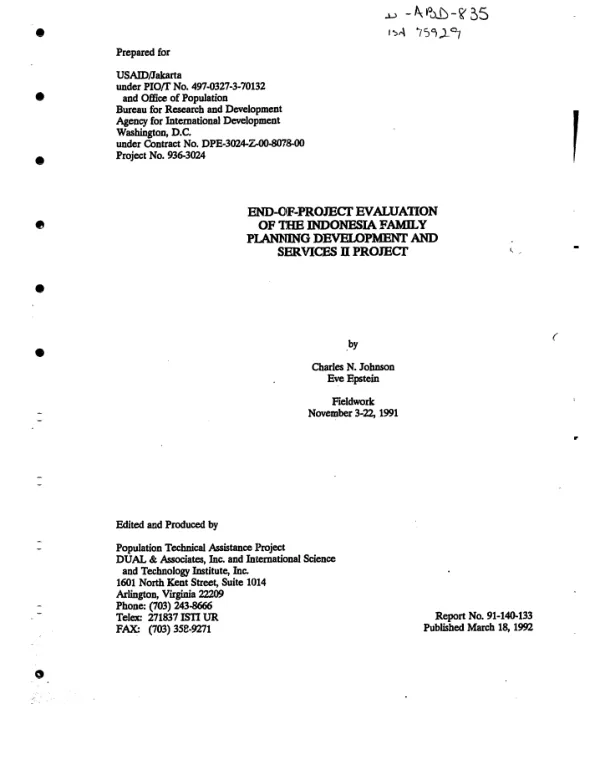
End-of-project evaluation of the Indonesia family planning development and services II project
Sign inDUAL & ASSOCIATES, INC.
End-of-project evaluation of the Indonesia family planning development and services II project
Final evaluation of a project to strengthen the capacity of the Indonesian National Family Planning Board (BKKBN) to expand the country"s family planning (FP) program.
Johnson, Charles N.; Epstein, Eve · 1992
Sign in to readA free account is required to download.
Abstract
The evaluation covers the period FY83-11/91. Overall, the project was highly successful. The BKKBN has received international acclaim for its achievements, innovative approaches, and dynamic leadership. During the 1980"s, contraceptive prevalence nearly doubled from 26% to 50%, while the total fertility rate declined from 5.6 children per woman in 1970 to 3.0 children in 1991. A rapid increase in the share of couples seeking contraceptive services through the private sector offers good evidence of the potential for this market and for the sustainability of the national FP program. In the component to expand village and sub-village level FP services, the project trained field workers and volunteers to distribute information and contraceptives and initiated cost recovery efforts. By project end, the BKKBN will have over 300,000 field workers and village volunteers in place, with future plans to train up to 10,000 village midwives annually. On the negative side, failure to collect baseline data made it impossible to measure the project"s impact in the low-prevalence subdistricts identified in the Project Paper. The urban component increased private sector participation in FP by initiating a contraceptive social marketing (CSM) program, along with an information and training program for private doctors, midwives, pharmacists, and the general public. These activities were followed by a mass media advertising campaign for the Blue Circle line of contraceptives, which may now be distributed by private providers. Problems included, inter alia, some decrease in efficiency due to the involvement of more organizations in FP management; inconsistencies between public and private sector promotion of FP; concerns about the feasibility of extending CSM beyond the largest cities; and the potential threat to the profitability of Blue Circle products from the subsidized sale of contraceptives by public providers. To promote voluntary sterilization (VS), the project renovated 380 hospitals and 230 clinics, and trained 386 doctor and paramedical teams, 1,060 counselors, 240 field workers, 2,109 BKKBN and MOH staff, and 148 community leaders. This component was constrained by the high cost of VS, despite BKKBN subsidies; lack of information about VS on the part of many women; frequent transfers of doctors, resulting in a need for continual training; and limited government funds for quality assurance systems. To improve management capacity, the project provided 130 computers for BKKBN (which previously had only one). headquarters and provincial offices. Funds were also provided for graduate-level training in the United States and Indonesia, short-term U.S. training. and establishment of an international center for foreign visitors to BKKBN. The training program succeeded only because of the presence of a full-time U.S. advisor, and plans to expand long-term training with World Bank support may cause BKKBN some management difficulties. The R&D component supported 51 local projects as well as a contraceptive prevalence survey. The component was hampered by problems with staffing, administration, and coordination, along with poor quality extramural research proposals. Nor was BKKBN"s research focus well-defined.