DUAL & ASSOCIATES, INC.
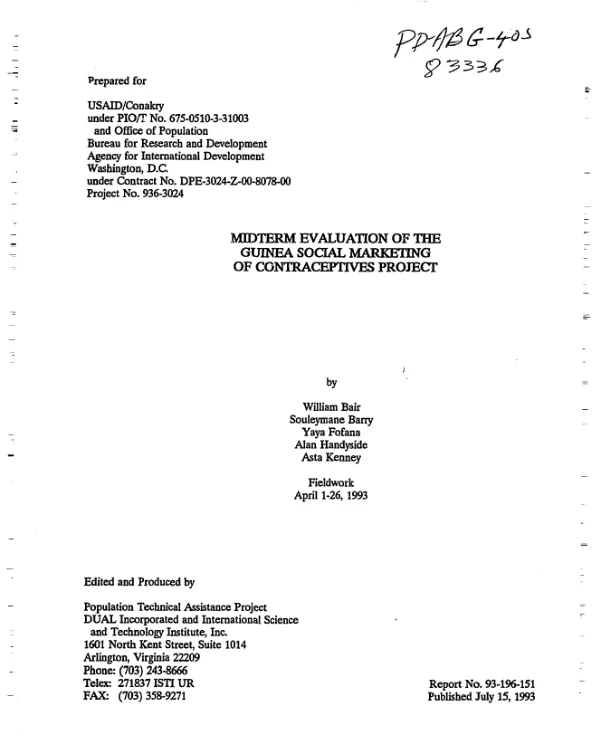
Midterm evaluation of the Guinea social marketing of contraceptives project
Evaluates project to increase family planning (FP) and prevent sexually transmitted diseases (STDs)/AIDS in Guinea.
Bair, William D.|Barry, Souleymane · 1993
Sign in to readA free account is required to download.
Abstract
Mid-term evaluation covers 8/91-4/93. Early informational and promotional activities by Population Services International (PSI), working in collaboration with the public sector National AIDS Committee (NAC) and the private Guinean Association for Family Well Being (AGBEF), have given the project good momentum. These efforts have been effective in launching Guinea's first major multi-media IEC campaign, which has focused on AIDS education and condom promotion; 14 TV and 32 radio spots have been aired in 5 languages, backed up by other educational materials. Public awareness of AIDS, STDs, and condoms has increased, at least in coastal areas and cities touched by national media; however, more work is needed to translate this awareness into condom use by the general population, not just high-risk groups. The project is beginning to move into FP messages, but, again, much more work must be done before promotion of oral contraceptives is begun. The IEC program also has an interpersonal communications component, which includes FP education via AGBEF and AIDS education via NAC. The latter has trained 593 community leaders who have conducted 1,800 educational sessions, reaching over 66,500 people nationwide. NAC is also addressing the concerns of conservative religious groups and has taken the lead in reaching young people, the project's main target group, though more is needed in this area. In the social marketing component, PSI, unable to find a local distributor, has recruited its own sales staff and sold some 2.1 million condoms to urban wholesalers and retailers, first to pharmacies, then later to less traditional outlets -- bars, night clubs, hotels, and small shops; it is unknown, however, how many have actually been sold to consumers. Considerably more effort is needed to convert awareness into actual use, and it is unlikely that targets for couple-years-of-protection will be met. To date, marketing efforts have focused on promoting condoms for AIDS prevention; sale of orals is just beginning. The objective to integrate FP into the Ministry of Health's primary health care (PHC) program is daunting because of the underfunded, overburdened nature of the PHC program. Efforts were further complicated when the MOH asked PSI to work in outlying regions rather than the more populous and accessible coastal regions or Conakry. PSI is rising to the challenge by supporting MOH-AGBEF collaboration in training, IEC, and program monitoring. A major project contribution has been its assistance in the production of MOH-approved national norms, standards, and training modules for integrating FP into PHC. These have been used in training 100 workers from 50 health centers and 34 supervisors, but it is too early for these efforts to have had much impact at the community level. The project has assisted in developing a national population policy and a family code, the latter with far-reaching implications for reproductive rights and the status of women. (Some women's groups view the project as male-oriented because of its high-profile promotion of condoms, but this perception should change as other aspects of the project become more visible.) PSI's project management has been lacking in some areas, but signs of improvement are becoming evident. AGBEF, for its part, has made a valuable contribution. The need for surgical clinical services (IUD and sterilization) presents an opportunity for further work on its part, but its management structure is too sorely stretched to respond.
![Innovations in family planning services [IFPS] project : midterm assessment report](https://covers.devme.ai/gen/5707.webp)