USAID DEC
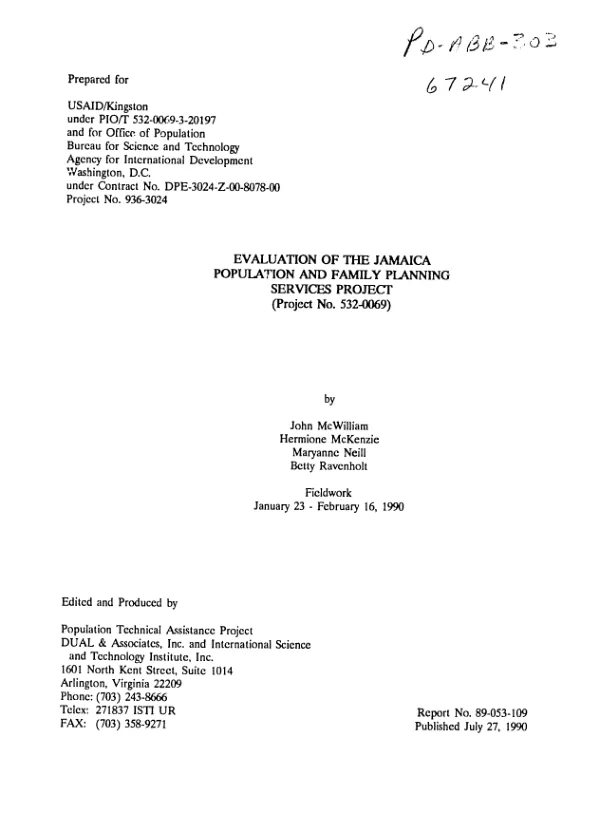
Evaluation of the Jamaica population and family planning services project (project no. 532-0069)
Sign inDUAL & ASSOCIATES, INC.
Evaluation of the Jamaica population and family planning services project (project no. 532-0069)
Interim evaluation of a project to expand family planning (FP) services in Jamaica, including commercial distribution of contraceptives, FP education, and the use of long-term contraceptive methods.
McWilliam, John|McKenzie, Hermione · 1990
Sign in to readA free account is required to download.
Abstract
The project has made strides toward reaching its goal of significantly reducing fertility. Contraceptive prevalence has increased and both age-specific and total fertility rates have declined. The Ministry of Health (MOH) health centers, which serve the majority of contraceptive users, provide high quality FP services and easy access for most women. Clinic services provided by the National Family Planning Board (NFPB) and Jamaica Family Planning Association are also of high quality. On the negative side, difficulties in cooperation betwen the MOH and the NFPB have arisen, and the NFPB's lack of strategic planning and reluctance to use TA have hindered project implementation. Commercial contraceptive distribution programs have enjoyed notable success. The two types of contraceptives distributed -- Perle oral pills and Panther condoms -- have virtually universal brand name recognition and make up the largest market share for pills (46.6%) and condoms (39.6%). The project has also increased awareness of the role of condoms in AIDS prevention. However, this component is constrained by the NFPB's structure, which inhibits flexible, timely responses to marketplace changes. The project has helped finance a field network of parish liaison officers and regional supervisors, which will provide a good base for organizing needed informational and motivational efforts. In addition, the NFPB is just beginning to mount a major information, education, and communication (IEC) program with assistance from other donors. Efforts to reach adolescents have had mixed results, largely because of an ill-conceived and expensive strategy to implement a large number of local subprojects. While these activities have reached many young people, some have provided only IEC, while others have had only weak linkages between IEC and FP services. As a result, the youth component has contributed a very small proportion to total contraceptives delivered under the project. Another shortcoming is this component's failure, despite the delivery of substantial inputs to the Ministry of Education, to integrate family life education into the country's school system. Referral systems for long-term methods -- i.e., IUD's and voluntary surgical contraception (VSC) -- are less than optimal. This, along with material and staff shortages, has resulted in fewer VSC procedures than expected. In addition, more training of nurses in IUD insertion is needed. Since contraceptives provided under the project are either received free or with a small donation, financial self- sufficiency is unlikely, as is the expansion of private sector FP services.