USAID DEC
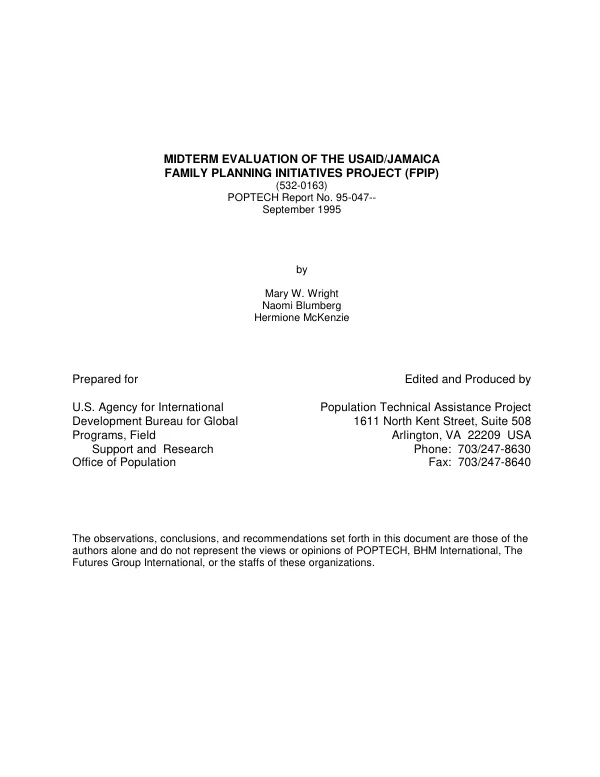
Midterm evaluation of the USAID/Jamaica family planning initiatives project (FPIP) (532-0163)
Sign inBASIC HEALTH MANAGEMENT INTERNATIONAL (BHM)
Midterm evaluation of the USAID/Jamaica family planning initiatives project (FPIP) (532-0163)
Mid-term evaluation (7/91-10/95) of a project to strengthen the capacity of Jamaica's National Family Planning Board (NFPB) to sustain its family planning (FP) promotion program following USAID's phase-out.
Wright, Mary W.|Blumberg, Naomi|McKenzie, Hermione · 1995
Sign in to readA free account is required to download.
Abstract
The project is well-designed, with many ambitious subprojects aimed at creating change in specific areas. Much progress has been made in some areas, while others need continued attention. The project has increased the contraceptive prevalence rate (CPR) from 55% in 1989 to 62% in 1993; conducted an impressive array of outstanding policy research and analysis, on which most FP programming has been based; and initiated Women's Center projects, which have elicited an enthusiastic response from the adolescent community and their parents in the limited areas where the projects are operating. The NFPB has successfully implemented, island-wide, the Top-Up Contraceptive Logistics Delivery System, which has improved recordkeeping, is popular with clinic staff, and has all but eliminated stock-outs. In addition, the project has completed the design and implementation of the major part of the Contraceptive Tracking System (CTS), which is utilized by the NFPB warehouse staff. The USAID phase-out (NFPB phase-in) for contraceptive procurement is proceeding on schedule, and contraceptives have been entered as a line item in the Government of Jamaica (GOJ) budget. In 11/92, the NFPB met the USAID conditions precedent to divest the Commercial Distribution of Contraceptives Program. This opened the door to assistance from the Social Marketing for Change (SOMARC) Project's assistance in starting the Personal Choice Social Marketing Program, which has undertaken a wide range of successful activities including training, extensive mass media campaigns, and public relations. In 11/94, the conditions precedent were met for the funding of the Family Life Education Program (FLE); the subproject proposal has been finalized and is awaiting official authorization. Two new computers have been acquired and installed, the Service Statistics Software has been installed and is operational, and a management information system (MIS) training workshop was held 10/93. However, the project faces some constraints. (1) In order for the NFPB to lobby successfully for the GOJ's continued financial and material support, it needs more time to develop advocacy skills. However, the Options for Population Policy Project (OPTIONS II) buy-in ends 9/95. (2) The hiring of a logistics manager, which has been recommended repeatedly for years, has not been done, although the position has been advertised. Constraints are related to position and salary approval from the Ministry of Public Service and reluctance of some NFPB staff to relinquish some of their responsibilities. (3) The NFPB is not able to conduct forecasting and procurement procedures independently; further TA must focus on technology transfer rather than service provision. (4) Three separate logistics systems are running concurrently: the main NFPB system, one for Depo-Provera, and one for condoms purchased for the Epidemiology Unit of the Ministry of Health (MOH). This complicates the forecasting and procurement of commodities. (5) The functions that would have been served by subcommittees of the Board of Directors (financial oversight, medical expertise to consider ideal method mix and means to shift toward it, and direct attention to sustainability issues) are not being performed because those subcommittees have not been appointed. Further, the Minister of Health has not yet appointed a full board of directors who would appoint the subcommittees. (Author abstract, modified)