BASIC HEALTH MANAGEMENT INTERNATIONAL (BHM)
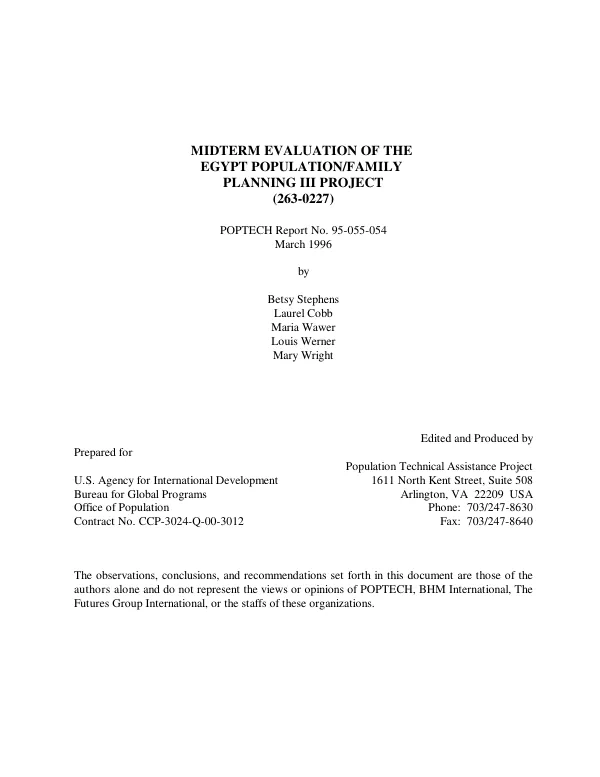
Midterm evaluation of the Egypt population/family planning III project (263-0227)
Evaluates umbrella project to support Egypt's national family planning (FP) efforts.
Stephens, Betsy|Cobb, Laurel · 1996
Sign in to readA free account is required to download.
Abstract
The project comprises 8 subprojects, implemented by the Ministry of Health, the National Population Council, the Ministry of Information, and the private sector. Mid-term evaluation covers the period 1992-3/96. The project is making good progress toward its targets for service volume, quality, and IEC. The MOH infrastructure alone includes a vast network of 3,706 units; no one is further than 5 km from a health care source. Focus has been on improving service quality and institutionalizing high-quality care and support systems. Training of the system development SP staff and similar support provided to the clinical service improvement subproject and the teaching hospital organization SP have strengthened their capacity to offer quality services. The project has supported an effective program of mass communication, local IEC activities, and interpersonal communication. Full and informed choice is an important dimension of quality and in the long term is indispensable to sustainability. One concern is the heavy reliance on the IUD, although a recent dramatic increase in the use of the injectable is encouraging. A great deal of progress has been made in developing the mission, strategy, structure, staff, and systems in the subprojects. However, the developments are scattered throughout the subprojects, and most of them need additional TA -- some short-term, some long-term -- for complete institutionalization. Although Egypt faces some difficult policy issues, there is no entity for which policy dialogue and formulation is a priority. Without such ground setting, there is a risk that Egypt's FP program will be unprepared for the inevitable financial and sectoral changes to come (i.e., eventual removal of free contraceptives given by foreign donors and changes in national price control strategies in all sectors). It is crucial that the new Ministry of Population and FP (MOPFP) and/or the NPC retain a strong orientation toward policy, planning, and research issues. The new Ministry is uniquely positioned to support the service and IEC activities of other ministries and agencies, to preclude duplication of efforts, and to help implementing agencies emphasize quality of service. Support for new service delivery activities is not recommended, since coverage is adequate. The pressing issues are service quality, efficiency, and cost-effectiveness. The project represents a radical change in management, with management placed under a single contract with 8 subprojects, unlike its predecessor, which had 24 subprojects supported through a series of cooperative agreements. This umbrella mechanism has distinct advantages; it facilitates coordinated planning and implementation and helps to ensure complementarity and avoid overlap. It also decreases USAID's management burden. USAID should retain the umbrella mechanism in the follow-on project, but consider a more flexible contracting mode. The rigidity of a contract forces a focus on deliverables rather than qualitative outputs and puts a heavy burden on all for detailed documentation. Either a cooperative agreement or performance-based contract would provide much more flexibility and permit all concerned to spend more time and resources on the program instead of the process. An important lesson learned is that the time frame is too short. The project, initially conceived as a 5-year effort, has been compressed into less than 4 years. This short period has forced an orientation toward detail (deliverables) and diverted attention from the big picture. Five years is the absolute minimum for a program with long-term goals and vision; 10 years would be better. This project should be extended and the follow-on designed with a 10-year time-frame. (Author abstract, modified)