PRAGMA CORP.
Midterm evaluation : primary health care support project, Mozambique
Evaluates project to strengthen primary health care (PHC) services in Mozambique.
Boddy, Peter|Johnson, Charles|Whitson, Donald · 1995
Sign in to readA free account is required to download.
Abstract
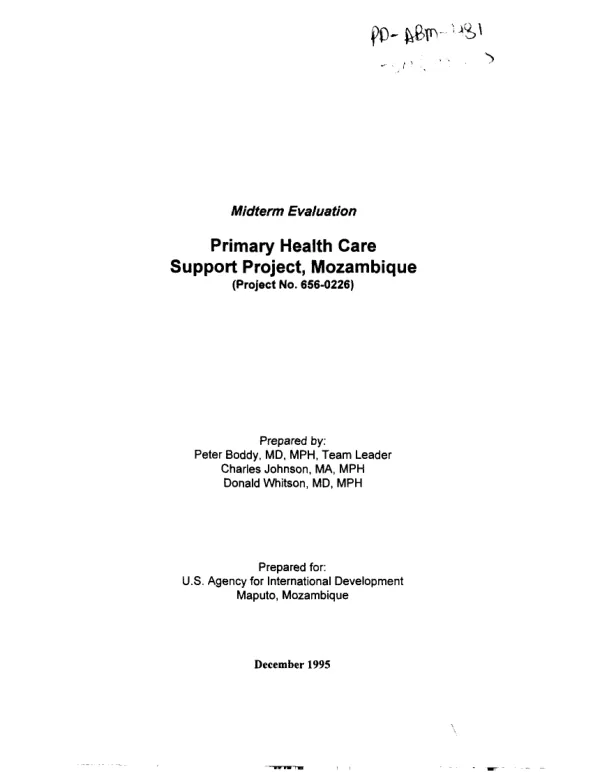
Mid-term evaluation covers the period 1991-9/95. In general, the inputs are suitable and appropriate for the outputs. The time programmed for the project is too short, and the level of inputs may not suffice to accomplish the outputs by the PACD. It is recommended that the PACD be extended at least 2 years, and the financial and TA inputs be supplemented as necessary. The project is precisely what the Ministry of Health (MOH) needs to accomplish a significant part of its goal of improving the productivity of health services through better management. The project strategy is to develop the capacity of the MOH through training and TA. Training takes time. The Essential Drugs Program (EDP) has responded to a significant need by distributing essential medicines to primary care centers. It is functioning with varying degrees of success in different provinces and districts. Staff training in logistics management, including supervision, has begun but needs strengthening at all levels. The logistics management and information systems are weak. The kit distribution system is somewhat inflexible, and is not responsive to health facilities with increased client load. The procedures for getting additional kits to meet growing demand are not well known to staff at health centers and posts. There are still shortages and stockouts of EDP kits in some places. Only one of three EDP supervisors has been hired. There is demand for family planning, but the health system is not prepared to respond. Contraceptive prevalence is extremely low, with higher rates in urban areas and lower rates in rural areas. Where health center and health post staff have received some family planning training, contraceptive prevalence is higher. Little IEC or staff training have been done to date. Two policy studies have been completed by short-term TA and MOH personnel. One deals with the delivery of PHC services through the private sector, the other with MOH budget allocations for prevention and PHC. The studies have provoked discussion and debate within the MOH which have led to policy decisions. A third study will be conducted in the near future and will focus on family planning, contraceptive, and reproductive health policies. There have been significant gains in strengthening a decentralized institutional capacity within the MOH. Planning and management capacities have noticeably improved in Niassa and Gaza, though not in Zambezia. An introductory management workshop was given in Gaza, Zambezia, and Niassa. A second workshop, on supervision, was given in the first two provinces, and is planned for Niassa in the near future. A 10-month intensive health systems management course is being partially financed by the project in Maputo. There are 22 participants, including three each from Gaza and Zambezia. A number of other training activities have been supported by the technical advisors. Systematic IEC activities have begun. Several staff members of the MOH Health Education Office (RES) have received initial training, though there is not yet a consistent counterpart for the long-term advisor. The advisor helped plan and supervise the collection of data for a KAP study of factors related to STDs/AIDS in the three project provinces. The data are currently being processed and analyzed. An initial assessment on decentralization was performed by short-term TA. The assessment report has already been discussed by MOH officials and further meetings are planned to help develop guidelines for decentralization. One hindrance has been frequent postponements required by the MOH due to conflicts with other obligations. A leadership workshop for MOH and provincial directors is being organized for the near future. The project has contributed significantly to virtually all aspects of the health strategic objective (SO) of the USAID/M Country Strategic Plan. The plan's overall goal is to enhance human productivity in Mozambique. A subgoal, improved health for women and children, was established as an important contributor to the goal. SO 3.0, increased use of essential maternal child health/family planning services, has three program and six subprogram outcomes (PO and SPO, respectively). The six components of this project are contributing to the fulfillment of all three of the POs, and to the six SPOs. (Author abstract)
Related documents
![Midterm evaluation of the quality assurance project [QAP] (cooperative agreement no. DPE-5992-A-00-0050)](https://covers.devme.ai/gen/7351.webp)
![Midterm evaluation of the quality assurance project [QAP] (cooperative agreement no. DPE-5992-A-00-0050)](https://covers.devme.ai/gen/36071.webp)