USAID. MISSION TO MOZAMBIQUE
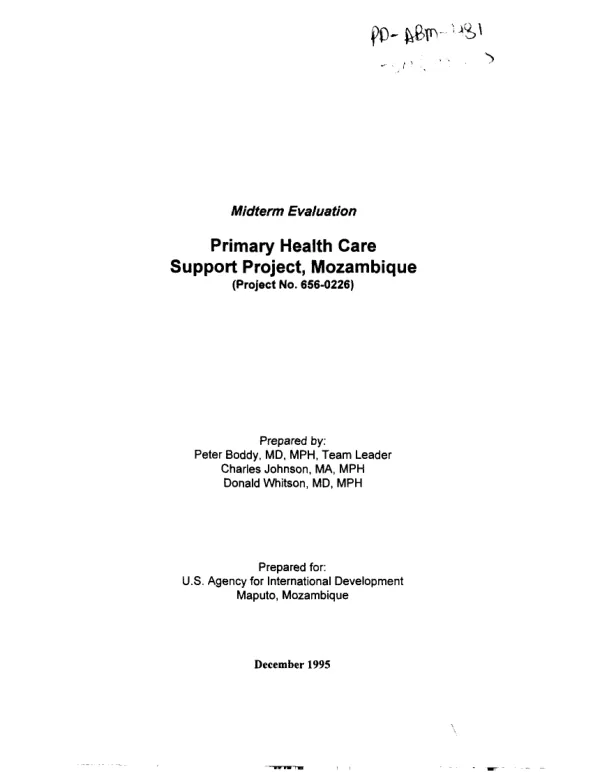
Primary health care support project
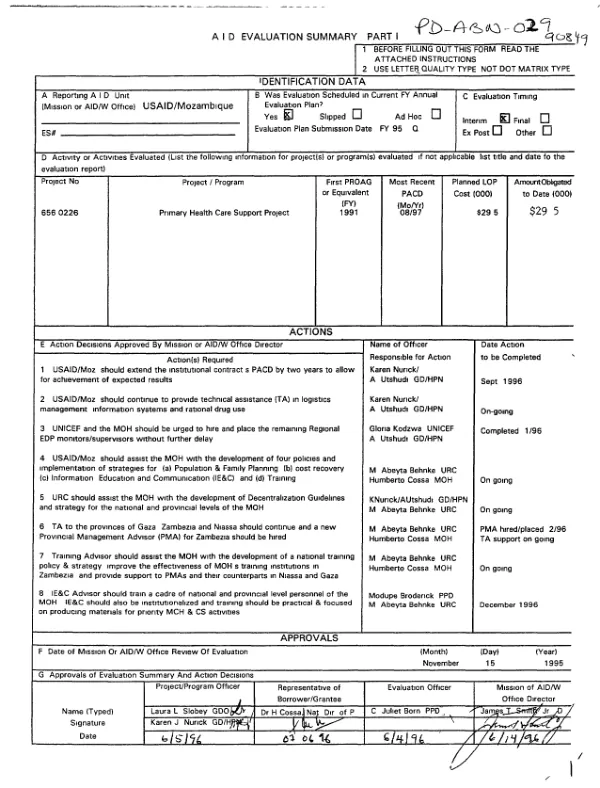
Summarizes interim evaluation (PD-ABM-481) of a project to strengthen primary health care (PHC) services in Mozambique.
1996
Sign in to readA free account is required to download.
Abstract
The evaluation covered the period 1991-9/95. The project is making progress and is precisely what the Government and the Ministry of Health (MOH) need to improve the productivity of health services through better management. However, a 2-year extension beyond the 8/97 PACD will be needed to reach EOPS targets. The Essential Drugs Program (EDP) is functioning nationally with varying degrees of success in different provinces and districts. The MOH is unlikely to have enough funds for drug procurement for many years; UNICEF has identified donors (e.g., the Dutch Government and the European Community) who are committed to providing some of the funding for EDP kits during the next few years. There are still shortages and stockouts of EDP kits; the distribution system is not responsive to facilities that have fluctuations in patient load and varying needs. Procedures for getting additional kits are not well known to staff at health centers and health posts. Both logistics management and logistics information systems are weak; EDP supervisors are needed. Staff training in logistics management, including supervision, has begun but needs strengthening at all levels. In provinces with good leadership and management, there are fewer problems. There is demand for family planning, but the health system is ill-prepared to respond. Contraceptive prevalence is extremely low, though higher in urban than rural areas. Where health center and health post staff have received some family planning training, contraceptive prevalence is higher. Little information, education, and communication (IEC) or staff training have been done to date. Two project-sponsored policy studies have been of some value to the MOH, but future projects should include funds for translations of studies and for seminars at which officials can discuss study findings. The MOH has acceptable policies in many areas. The greatest need now is for TA to help implement policies, especially in decentralization, training, and PHC management. Areas in which the MOH could still use some policy assistance include population policy, cost recovery, and IEC. Progress is being made with respect to decentralization to the provincial level, although more TA is needed. Recommendations are made in the following areas: EDP; policy; decentralization; training; and IEC. The following lessons have been learned. (1) TA and training are mutually reinforcing and produce better results when used together. Training alone is generally not sufficient. (2) Projects should have the flexibility to adapt to changing conditions and to extend their time frames to address unforeseen constraints and opportunities. (3) The establishment of long-term advisors is a relatively long process. Advisors and counterparts should be adequately prepared to perform their responsibilities and work together. This requires not only clear definition of objectives and constraints by all, but also specific team-building efforts. Advisors should possess not only technical knowledge, but also interpersonal and communication skills, and be able to integrate as a team. Language ability is important, but less important than technical skills and experience. (4) Provincial activities need national support to be effective and vice versa. National policies and strategies should be adapted and replicated in provincial policies and activities. (5) Misuse of resources and corruption need to be dealt with directly and continuously. These issues have not been specific concerns of the project; nevertheless, they are concerns of staff, donors, and the beneficiary population. USAID/M generally concurred with the evaluation, but disagreed with the recommendation to abandon the Mozambican Association for Family Development (AMODEFA) in the project"s IEC activities, although the Mission is reconsidering possible other counterparts.
Related documents