USAID DEC
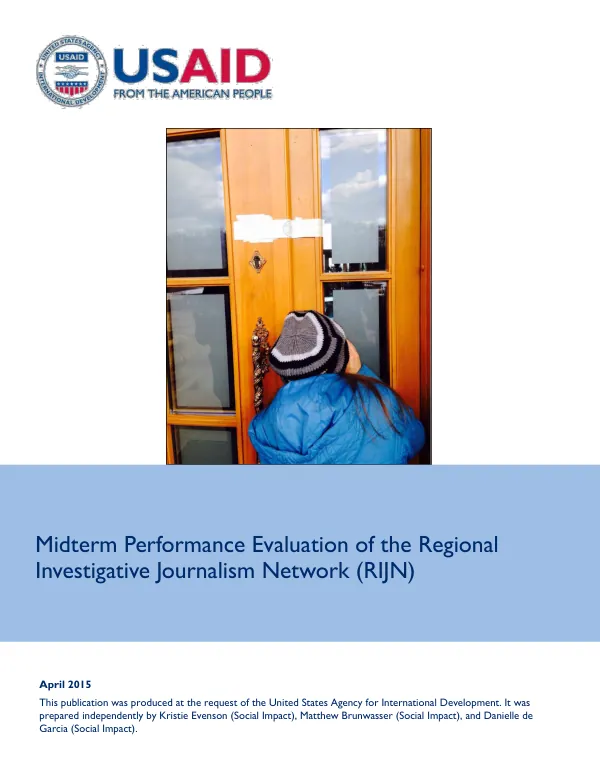
Midterm Performance Evaluation of the Regional Investigative Journalism Network (RIJN)
Sign inSOCIAL IMPACT, INC.
Midterm Performance Evaluation of the Regional Investigative Journalism Network (RIJN)
The Regional Investigative Journalism Network (RIJN) was established to promote high-quality public interest investigative journalism in the Balkans, Western Eurasia, and Caucasus regions.
2015 · 128 pages
Sign in to readA free account is required to download.
Abstract
The project's primary goal is to build citizen demand to reduce corruption, fraud, and other criminal activities through increased exposure to professionally produced investigative journalism. The RIJN is part of the broader Organized Crime and Corruption Reporting Project (OCCRP) replication in other parts of the world. The project's theory of change hypothesizes that creating demand for good governance requires high-quality public interest investigative journalism. This type of journalism offers in-depth, consistent, and even-handed investigations that expose significant corruption damaging public life. The RIJN aims to achieve this goal by providing training and capacity-building programs for journalists, promoting collaborative reporting, and supporting the production of high-quality investigative stories. The evaluation of the RIJN was conducted using a mixed-methods approach, which included document review, online surveys, field visits, and key informant interviews. The evaluation team conducted a case study analysis of six OCCRP-produced stories to examine the linkages between OCCRP stories' potential impacts. The evaluation aimed to assess the feasibility of the RIJN activity and to fine-tune the current project for the next cycle of operation. The evaluation found that the RIJN has made significant progress in improving the professional skills and standards of individual journalists. The project has also contributed to building and strengthening sustainable linkages between journalists. Collaborative activities, such as joint reporting and story-sharing, have been particularly helpful to journalists participating in the project. The evaluation also found a correlation between RIJN/OCCRP reporting and public policy actions. The project's investigative stories have led to changes in policy and practice, and have contributed to increased transparency and accountability in the regions where the project operates. However, the evaluation also identified challenges and limitations in measuring the effects of investigative journalism. The evaluation concluded that the RIJN has made significant progress in achieving its goals, but that there are opportunities for improvement. The project's replication in other parts of the world requires careful consideration of the lessons learned from the RIJN experience. The evaluation recommended that future efforts to replicate investigative journalist networks should focus on building strong partnerships with local media outlets, promoting collaborative reporting, and supporting the production of high-quality investigative stories. The RIJN's experience has shown that high-quality public interest investigative journalism can have a significant impact on promoting good governance and reducing corruption. The project's success has been attributed to its focus on building the capacity of individual journalists, promoting collaborative reporting, and supporting the production of high-quality investigative stories. The RIJN's experience provides valuable lessons for future efforts to promote investigative journalism and good governance in other parts of the world.
Related documents