USAID
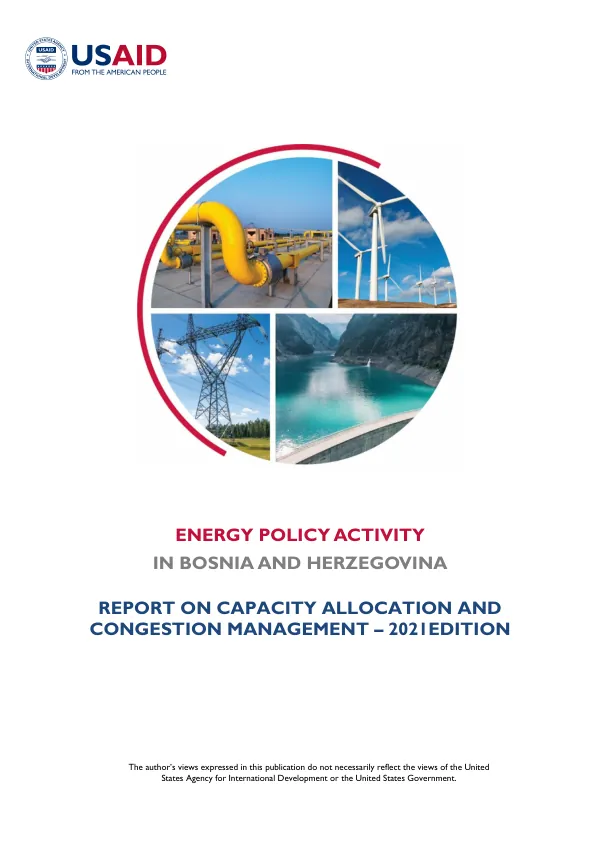
Report on Capacity Allocation and Congestion Management – 2nd Edition
Capacity allocation and congestion management are critical components of the natural gas pipeline system in Bosnia and Herzegovina.
2021 · 60 pages
Sign in to readA free account is required to download.
Abstract
The Energy Policy Activity (EPA) in Bosnia and Herzegovina has published a report on capacity allocation and congestion management, which provides a comprehensive review of the EU-required legal, regulatory, and operational requirements related to these issues. The report discusses the conceptual theory of capacity allocation mechanisms and congestion management, as well as the various provisions set out in the EU 3rd Gas Directive, Regulations, and Decisions. The document also presents experiences from other countries, including the Czech Republic, Serbia, and Croatia, and analyzes the status quo in Bosnia and Herzegovina, the Federation of Bosnia and Herzegovina (FBiH), and Republika Srpska (RS). Capacity allocation refers to the process of allocating transport capacity to network users, while congestion management provides specific rules on how congestion is handled and how capacity allocation is handled under congestion conditions. The rules for capacity allocation and congestion management are decisive for efficient use of the available physical transport capacities. The capacity allocation process can be divided into six steps, including product/capacity definition and assessment, capacity allocation, congestion management and optimization, capacity optimization, and pricing. The individual steps are explained in detail in the report, which also provides a comprehensive overview of the current situation in the BiH gas sector. The report highlights the importance of capacity allocation and congestion management in ensuring the efficient use of the available physical transport capacities. It also emphasizes the need for a comprehensive regulatory framework that takes into account the specific needs and challenges of the BiH gas sector. In the context of Bosnia and Herzegovina, the report notes that the transmission network itself has not changed, and the legal framework has only undergone minor changes. However, the report emphasizes the need for a more comprehensive and coordinated approach to capacity allocation and congestion management, particularly in the context of the EU's Third Energy Package. The report provides a number of recommendations for improving capacity allocation and congestion management in Bosnia and Herzegovina, including the development of a more comprehensive regulatory framework, the establishment of a capacity allocation mechanism, and the implementation of congestion management procedures. The report also emphasizes the need for closer cooperation and coordination between the various stakeholders involved in the BiH gas sector, including the transmission system operators, the regulatory authorities, and the market participants. Overall, the report provides a comprehensive and detailed analysis of the capacity allocation and congestion management issues in Bosnia and Herzegovina, and highlights the need for a more comprehensive and coordinated approach to these issues. The report's recommendations are based on the analysis of the current situation in BiH, FBiH, and RS, and are intended to provide a framework for improving the efficiency and effectiveness of the BiH gas sector.