USAID DEC
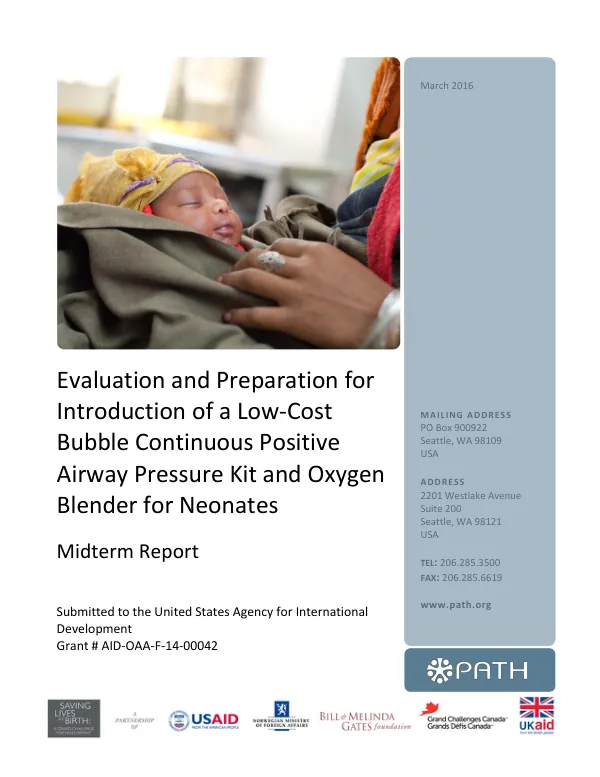
Midterm Report: Evaluation and Preparation for Introduction of a Low-Cost Bubble Continuous Positive Airway Pressure Kit and Oxygen Blender for Neonates
Sign inPATH
Midterm Report: Evaluation and Preparation for Introduction of a Low-Cost Bubble Continuous Positive Airway Pressure Kit and Oxygen Blender for Neonates
Respiratory distress syndrome (RDS) is a condition resulting from a lack of surfactant and underdeveloped lungs, affecting the majority of babies born prematurely.
2016 · 138 pages
Sign in to readA free account is required to download.
Abstract
Continuous positive airway pressure (CPAP) therapy is a widely accepted treatment for RDS, but its implementation is often hindered by the lack of access to suitable equipment in low-resource settings. In response to this challenge, PATH has been working to develop a low-cost bubble continuous positive airway pressure (bCPAP) kit and oxygen blender for neonates. The bCPAP kit is designed to employ inexpensive components commonly found in hospitals, including oxygen tubing, stopcocks, microburettes, and nasal cannulae. A unique feature of the kit is the inclusion of a PATH-designed inline, passive air-oxygen blender. This blender provides a stable source of blended gas, regardless of user input, and can be used with any bCPAP system where pressurized oxygen is available. The kit does not require electricity or a source of pressurized air for use, making it accessible to a broader range of medical settings. PATH has been working to refine the components of the preassembled kit and has conducted a stakeholder workshop in Uganda to collect user feedback. The organization has also met with ministry of health officials in several countries to better understand procurement and policy, and has visited health care facilities to share information on the kit and understand best use-cases for early adoption. A list of potential blender manufacturers and kit distributors has been compiled, and meetings with these stakeholders are planned as a next step. The development of the bCPAP kit and oxygen blender is a critical step towards improving access to CPAP therapy for neonates in low-resource settings. PATH's work in this area has the potential to save countless lives and improve health outcomes for vulnerable populations. The organization's focus on refining the kit and preparing it for manufacture, assembly, and scale-up is a key component of this effort. PATH's approach to developing the bCPAP kit and oxygen blender has been guided by a conceptual framework that emphasizes the importance of user-centered design and the need for a low-cost, prepackaged kit that can be easily assembled and used in a variety of settings. The organization has worked closely with stakeholders, including healthcare workers, ministry officials, and manufacturers, to ensure that the kit meets the needs of users and can be effectively implemented in a range of settings. The development of the bCPAP kit and oxygen blender is a complex process that requires careful consideration of a range of factors, including the technical requirements of the device, the needs of users, and the logistical challenges of implementation. PATH's work in this area has been informed by a range of activities, including stakeholder workshops, facility visits, and market assessments. The organization's focus on refining the kit and preparing it for manufacture, assembly, and scale-up is a critical component of this effort. PATH's midterm report provides a comprehensive overview of the organization's progress to date and outlines the next steps in the development of the bCPAP kit and oxygen blender. The report highlights the importance of user-centered design and the need for a low-cost, prepackaged kit that can be easily assembled and used in a variety of settings. The organization's work in this area has the potential to save countless lives and improve health outcomes for vulnerable populations.