OHIO STATE UNIVERSITY. DEPT. OF AGRICULTURAL ECONOMICS AND RURAL SOCIOLOGY
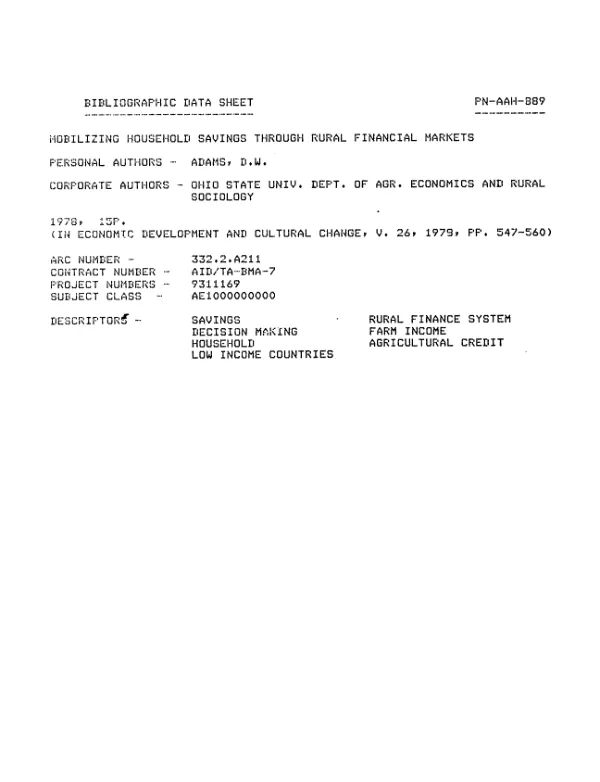
MOBILIZING HOUSEHOLD SAVINGS THROUGH RURAL FINANCIAL MARKETS
Contrary to the usual assumptions that rural families in low-income countries are either too poor to save or spend their surplus income on consumption or ceremonial sprees, this paper argues that rural households have substantial voluntary savings capacities and that rural financial markets (RFM) can strongly influence both the form and the amount of savings.
ADAMS, DALE W. · 1970
Sign in to readA free account is required to download.
Abstract
According to the author, the amount of farm income saved depends on both household consumption and farm production. Although the interaction between these factors is complex and hence difficult to quantify, one can generally assume a close inverse relationship between the rates of return expected on savings and the amount of income allotted to consumption. RFM"s can influence family financial behavior by increasing liquidity, e.g., through credit, for both production and consumption and by offering attractive interest rates for savings. Data from Taiwan, Japan, Korea, Malaysia, and India indicate that rural households possess a significant savings capacity. There are three strong reasons, according to the author, for mobilizing this capacity: (1) rural savings may help strengthen a country"s overall financial market; (2) they can strengthen the local service institutions which are often weakened by concessionary interest rates and so help bridge the gap between national organizations and individuals; and (3) increased savings lead to decreased household consumption. A two-level strategy to mobilize voluntary savings is suggested. At the national level, a flexible interest rate structure is needed, e.g., one that incorporates tax exemptions on interest for certain types of deposits or indexes return rates according to inflation, along with legal changes to permit cooperatives and other local institutions to handle credit and savings activities and to integrate these institutions into regular financial markets. Initiation of a nationwide deposit insurance program is also needed. On the local level, the key need is to promote attractive return rates. Programs to promote savings, it is noted in conclusion, are best pursued in areas where agricultural growth and increased income are occurring.
Related documents