USAID DEC
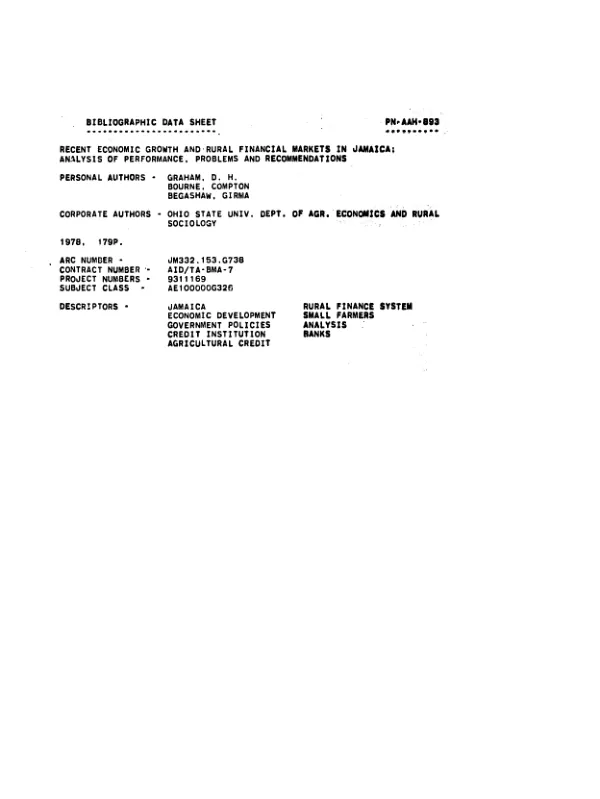
RECENT ECONOMIC GROWTH AND RURAL FINANCIAL MARKETS IN JAMAICA : ANALYSIS OF PERFORMANCE, PROBLEMS AND RECOMMENDATIONS
Sign inOHIO STATE UNIVERSITY. DEPT. OF AGRICULTURAL ECONOMICS AND RURAL SOCIOLOGY
RECENT ECONOMIC GROWTH AND RURAL FINANCIAL MARKETS IN JAMAICA : ANALYSIS OF PERFORMANCE, PROBLEMS AND RECOMMENDATIONS
Against a background analysis of the Jamaican economy"s acclerating decline from 1965 to 1978, this paper studies the recent performance of Jamaica"s rural financial markets (RFM"s).
GRAHAM, DOUGLAS H.; BOURNE, COMPTON +1 more · 1970
Sign in to readA free account is required to download.
Abstract
From 1970 to 1977, credit increased rapidly, 6.7 fold, in nominal terms, but real growth was only 2.6 fold. Most of the increase came from new programs such as the Self-Supporting Farmer"s Development Program (SSFDP) and the Jamaican Development Bank (JDB) with the help of foreign funds as inflation eroded the credit base in older domestic sources such as the Agricultural Credit Board (ACB). This rapid increase in credit within a declining economy has led to delinquency and arrears which have compromised future access to foreign funding sources, and to negative real interest rates which have benefitted large farmers while undermining the viability of the credit institutions themselves. More detailed analysis of the performance of the commercial banks, the overall main source of farm credit; the JDB, the major vehicle for official farm credit; and the three government programs designed to provide small farmer credit -- People"s Cooperative Banks (PCB), the SSFFDP, and the Crop Lien Program -- confirm the above conclusions. Analysis of the impact of public financial policies on RFM"s leads to the conclusions that government assistance has been irregular and has directly benfitted only a narrow range of industries and that central banking policies have not succeeded in providing an adequate flow of private sector credit to agriculture. A final section discusses the main problems caused by the above factors: negative interest rates that benefit large farmers and penalize savers; inefficient use of credit and arrears by large farmers, due to lax loan administration; and high delinquency rates that threaten the viability of the small farmer credit programs. Recommendations include raising interest rates according to the rate of economic recovery; improving loan appaisal and collection procedures, especially of the JDB; and transferring parts of the Crop Lien program to the SSFDP and of ACB-PCB services to the Ministry of Agriculture while supporting ACB-PCB"s paricipation in the new Farmer Savings Program. Specific areas of USAID/J assistance are suggested.