TETRA TECH ESI, INC.
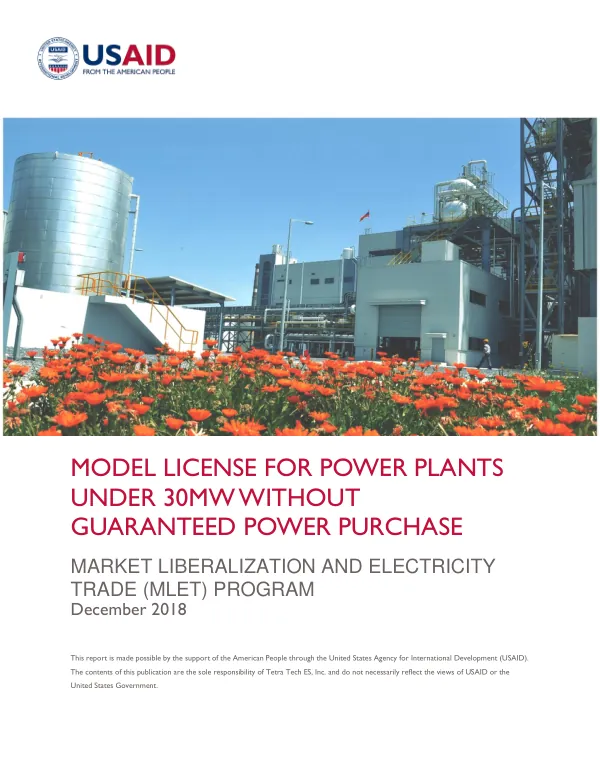
Model License for Power Plants Under 30 MW Without Power Purchase Guarantee
The Model License for Power Plants Under 30 MW Without Power Purchase Guarantee has been developed under the USAID Market Liberalization and Electricity Trade (MLET) Program.
2018 · 10 pages
Sign in to readA free account is required to download.
Abstract
The program aims to support the Power Market reforms, energy sector strategy development, and promote cross-border trade with Georgia. This includes working towards facilitation of Armenian regulatory practices and harmonization of the Power System standards with the EU directives. The Model License clarifies rights and responsibilities defined by the Public Services Regulatory Commission for power plants in compliance with the RoA Energy Law requirements. It also defines cases of supervision over license operation and imposition of fines. The license is focused on power plants with a capacity of less than 30 MW without a guaranteed power purchase. The license holder, referred to as the Licensee, has the right to construct and operate a power plant with a specified capacity. The Licensee is responsible for construction of the power plant within the defined period and has the right to generate electricity and thermal energy. The Licensee can sell or export its own electricity on the wholesale market, buy electricity on the wholesale market if its own electricity is not sufficient, and use electricity for its own needs. Implementation of the licensed activity must comply with the RoA Energy Law, other laws, this License, Transmission Network Code, Trading Rules, legal acts approved by the Commission, and other legal requirements. The Licensee must submit plant construction design documents to the Commission, register contracts signed on the wholesale market, and follow the instructions of the System Operator. The Licensee is required to ensure access of representatives of the Commission to the property necessary to perform the licensed activity and involved in that activity. The Licensee must submit information and reports on its licensed activity in procedures and forms approved by the Commission. The Licensee is held responsible for the reliability of reports and other information provided to the Commission. The licensed activity is supervised by the Commission, which has the right of full access to the Licensee's premises in procedures defined by the Commission. The Licensee must support the Commission in performing supervision of the licensed activity. The Licensee is required to immediately inform the Commission about any circumstance that caused violation of the License conditions or may become a direct reason for such violation. The validity of the License does not refer to other entities engaged in joint activities with the Licensee, including activities by joint contracts, as well as to legal entities founded or acting with participation of the Licensee. The Licensee must ensure that its economic activity does not endanger the fulfillment of this license conditions, and the accounting of this licensed activity should be separated from the accounting of other activities implemented by the Licensee.