CHEMONICS
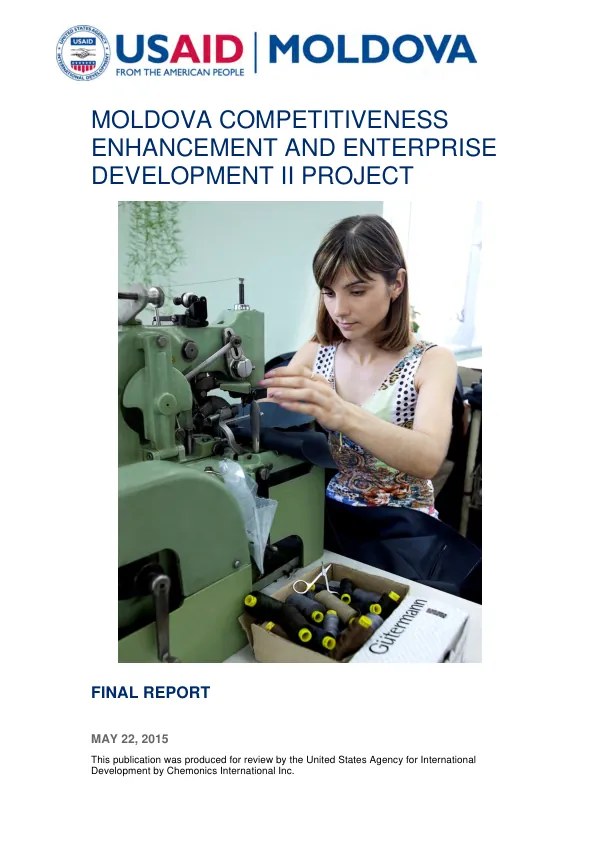
Moldova Competitiveness Enhancement and Enterprise Development II Final Report
The Competitiveness Enhancement and Enterprise Development (CEED) II project was implemented in Moldova from December 2010 to June 2015.
2015 · 111 pages
Sign in to readA free account is required to download.
Abstract
The project was funded by USAID/Moldova and implemented by Chemonics International Inc. in partnership with Dexis Consulting Group. The project aimed to grow and expand the competitiveness and efficiency of key industries in Moldova, leading to increased sales and investment. The CEED II project supported five sectors: apparel, footwear, and accessories; information technology; tourism; furniture; and wine. The project used a mix of micro-, mezzo-, and macro-level technical assistance and training activities to strengthen and boost the competitiveness of the five targeted sectors. Value chain activities helped increase sales of Moldovan goods and services to final markets by eliminating inefficiencies and constraints along the vertical value chain. Cluster activities strengthened horizontal linkages among sector stakeholders by working through industry associations or member-based organizations to advocate for legal and regulatory changes; disseminate information; provide services such as organizing trade and investment missions, training, or conferences for their members; and coordinate initiatives within targeted sectors. In the apparel, footwear, and fashion accessories sector, CEED II achieved several notable results. The share of low-value, cut-and-make services as a percentage of total sector output decreased from 95 percent in 2005 to 80 percent in 2014. More than 70 new generation brands emerged as the backbone of the Moldovan fashion industry. The umbrella brand, Din Inima: Branduri de Moldova, raised the sector's profile and attracted Moldovan consumers. The campaign united more than 60 Moldovan brands, and companies cooperated to open multi-brand shops and expand their own brands. Nearly 700 participants received training to improve efficiency and product quality through enhanced design, marketing, manufacturing, and technology skills. In the information technology sector, CEED II also achieved significant results. The Cisco IT Essentials program was launched under the CEED program in 2008. In the 2012-2013 academic year, Moldova's Ministry of Education approved Cisco IT Essentials as a high school elective. Over the life of the project, more than 170 teachers were trained and more than 1,000 pupils enrolled nationwide. CEED II helped update the national informatics curricula for lower and upper secondary education to meet industry needs. Nearly 60 schools introduced the curriculum beginning in September 2014. CEED II also facilitated a public-private partnership among government, Microsoft, IBM, and USAID for the creation of the national Information Technology Center of Excellence. Access to finance for the sector was improved via a $1.2 million Development Credit Authority loan guarantee. CEED II motivated the Ministry of Information Technology and Communications and the Association of Private Information and Communications Technology Companies to work together to improve the business environment in the sector. Overall, the CEED II project made significant contributions to the economic growth objective and private sector competitiveness program area of the U.S. Foreign Assistance Framework. The project's achievements in the apparel, footwear, and fashion accessories sector, as well as the information technology sector, demonstrate its effectiveness in promoting competitiveness and economic growth in Moldova.
Related documents
Documents in this collection

USAID DEC
The Moldova Competitiveness Enhancement and Enterprise Development II (CEED II) project
Open record
USAID DEC
The Moldova Competitiveness Enhancement and Enterprise Development II (CEED II) project
Open record
USAID DEC