USAID DEC
The Moldova Competitiveness Enhancement and Enterprise Development II (CEED II) project
Sign inMICROSOFT CORPORATION
The Moldova Competitiveness Enhancement and Enterprise Development II (CEED II) project
The Moldova Competitiveness Enhancement and Enterprise Development II (CEED II) project aims to grow and expand the competitiveness and efficiency of key industries in Moldova, leading to increased sales and investment.
4 pages
Sign in to readA free account is required to download.
Abstract
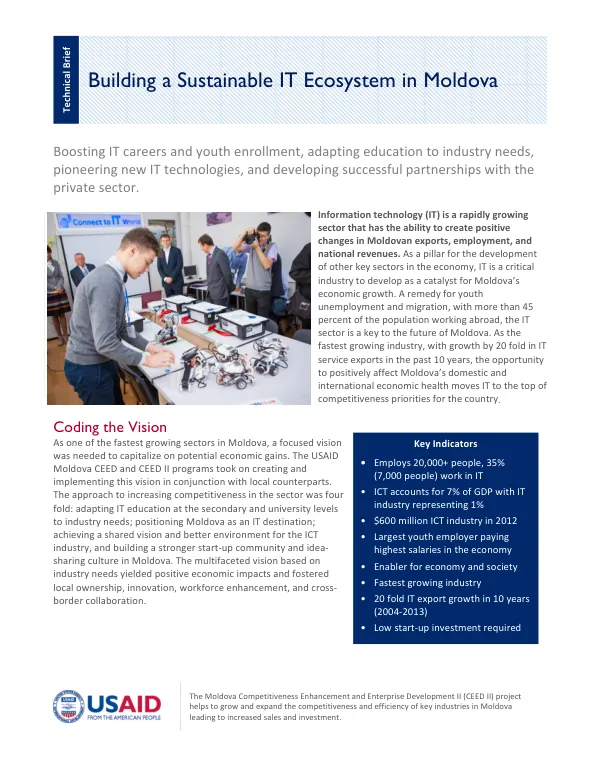
The project focuses on boosting IT careers and youth enrollment, adapting education to industry needs, pioneering new IT technologies, and developing successful partnerships with the private sector. Information technology (IT) is a rapidly growing sector that has the ability to create positive changes in Moldovan exports, employment, and national revenues. As a pillar for the development of other key sectors in the economy, IT is a critical industry to develop as a catalyst for Moldova's economic growth. A remedy for youth unemployment and migration, with more than 45 percent of the population working abroad, the IT sector is a key to the future of Moldova. The CEED II program took on creating and implementing a vision for the IT sector in conjunction with local counterparts. The approach to increasing competitiveness in the sector was fourfold: adapting IT education at the secondary and university levels to industry needs; positioning Moldova as an IT destination; achieving a shared vision and better environment for the ICT industry; and building a stronger start-up community and idea-sharing culture in Moldova. The multifaceted vision based on industry needs yielded positive economic impacts and fostered local ownership, innovation, workforce enhancement, and cross-border collaboration. The CEED II program facilitated a public-private partnership among government, Microsoft, IBM, and USAID for the creation of a national IT Centre of Excellence (ITCE), and access to finance was improved for the industry via a $1.2 million DCA loan guarantee. A key constraint to fostering a more mature IT sector was the insufficiency of skilled labor due to migration of qualified people and the existing gap between the skills acquired by students and private sector needs. For firms to grow and for scalability to be reached in proven sector interventions, education adapted to industry needs was required. Ionela Titirez, CEED II IT Team Leader, notes, "IT companies had too many contracts they could hardly fill because they did not have enough skilled people to do it. In order for these firms to grow, they had to invest in education." Educating through Cisco IT Essential Courses has been a successful initiative. Since 2008, more than 3,000 students, ranging from ages 14 to 19, have successfully completed the Cisco IT Essential Courses and have learned software and hardware basics, including how to assemble a computer and set up an Internet network. The national Informatics curriculum for lower and upper secondary education has been updated to match international best practices and to be more attractive for students. In academic year 2014-2015, 57 high schools piloted the new curriculum. The vision for improving human capacity is to adapt education to industry needs while strengthening the IT workforce through partnerships with high schools, colleges, universities, and the private sector to improve IT training and promote IT careers. The quality of students entering the IT sector after the IT Orientations has increased, and the interest of students taking on a career in IT has grown, with students seeking it out.
Related documents