USAID DEC
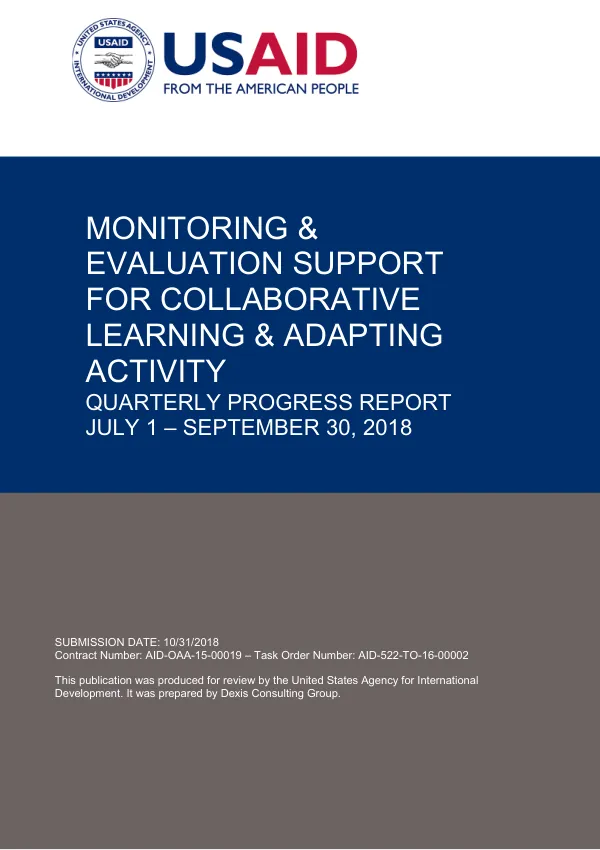
Monitoring & Evaluation Support for Collaborative Learning and Adapting (MESCLA) Quarterly Progress Report
Sign inECO CONSULTING GROUP
Monitoring & Evaluation Support for Collaborative Learning and Adapting (MESCLA) Quarterly Progress Report
The Monitoring and Evaluation Support for Collaborative Learning and Adapting (MESCLA) Activity is a program implemented by Dexis Consulting Group for the United States Agency for International Development's Mission in Honduras (USAID/Honduras).
2018 · 34 pages
Sign in to readA free account is required to download.
Abstract
The program consists of four interrelated components: evaluation, monitoring, design and conduct analyses, surveys, studies, and assessments, and support for improved knowledge management, learning, and community within the Mission and external stakeholders. During the quarter of July to September 2018, MESCLA worked on each component of the contract. In the evaluation component, MESCLA conducted a pilot impact evaluation for the Empleando Futuros (EF) program, but due to high levels of attrition in the treatment group, it was impossible to evaluate the outcomes of the treatment group in comparison with the control group. MESCLA recommended learning from the pilot impact evaluation measurement and that USAID cancel the rest of the pilot impact evaluation to focus instead on conducting a robust performance evaluation. MESCLA also recalibrated the Violence Involved Persons Risk Assessment (VIP-RA) evaluation tool, incorporating additional data for 2000 youth. USAID approved the technical document describing the recalibration and new scoring of the tool, as well as the modified VIP-RA that includes gang involvement questions. MESCLA presented the timeline for the performance evaluation and a detailed implementation methodology, discussing these thoroughly with implementing partner Banyan and submitting them to USAID. In the monitoring component, MESCLA reviewed and provided feedback on the Gobernanza en Ecosistemas, Medios de Vida y Agua (GEMA) evaluations design and workplan, as well as data collection instruments including the household survey questionnaire. The subcontractor International Advisory, Products and Services (i-APS) began baseline data collection in September. MESCLA and the Contracting Officer Representative suggested that i-APS focus on evaluating the approach and methodology implemented by Zamorano, a GEMA implementing partner, to avoid duplication of efforts. In the design and conduct analyses, surveys, studies, and assessments component, MESCLA subcontracted Vanderbilt University to conduct a performance evaluation for the Honduras Local Governance (HLG) program. Vanderbilt University completed fieldwork and produced a Preliminary Findings Report as well as a Draft Evaluation Report. MESCLA also requested consent to subcontract with Zamorano to conduct around six Feed the Future (FtF) case studies to complement information obtained through the performance evaluation. In the knowledge management, learning, and community component, MESCLA held planning meetings with subcontractors and implementing partners to discuss the performance evaluation and case studies. MESCLA also identified weaknesses in performance during the inception field visits and requested that NORC at the University of Chicago replace its Production, Risk, Microenterprise, and Added Value Chain Specialist. The MESCLA Activity has made significant progress in implementing its components, including evaluations, monitoring, design and conduct analyses, surveys, studies, and assessments, and support for improved knowledge management, learning, and community. The program has also identified areas for improvement and has taken steps to address these weaknesses. The MESCLA Activity has several key activities planned for the next quarter, including the commencement of technical work for the GEMA IE and PE, the completion of the FtF PE and case studies, and the continuation of the HLG PE. The program will also continue to provide support for improved knowledge management, learning, and community within the Mission and external stakeholders. The MESCLA Activity has several performance indicators that measure its progress and impact. These indicators include the number of evaluations and performance evaluations completed, the number of implementing partners and subcontractors engaged, and the level of knowledge management, learning, and community support provided. The MESCLA Activity has several budget lines that support its components and activities. These budget lines include funding for evaluations, monitoring, design and conduct analyses, surveys, studies, and assessments, and support for improved knowledge management, learning, and community. The MESCLA Activity has several subcontractors and implementing partners that support its components and activities. These subcontractors and implementing partners include Vanderbilt University, International Advisory, Products and Services, and Zamorano. The MESCLA Activity has several subcontractors and implementing partners that support its components and activities. These subcontractors