USAID DEC
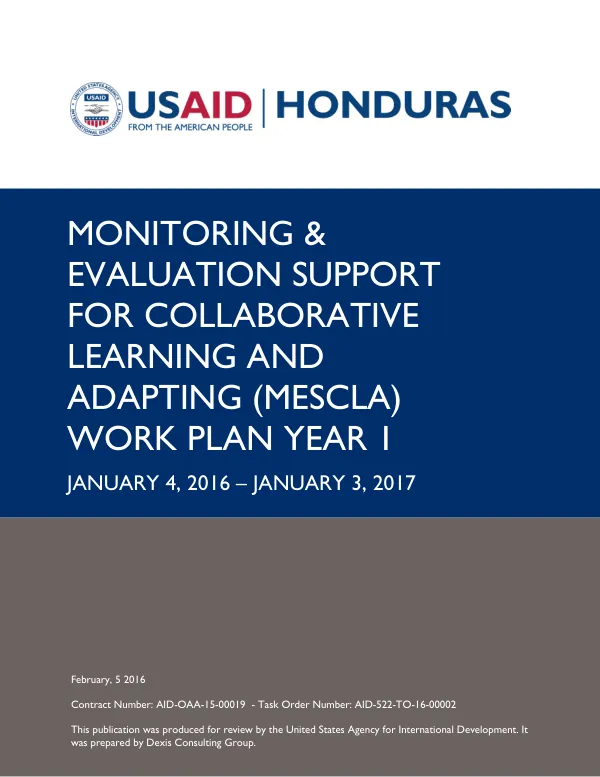
Monitoring & Evaluation Support for Collaborative Learning and Adapting (MESCLA) Work Plan Year 1
Sign inAECOM INTERNATIONAL
Monitoring & Evaluation Support for Collaborative Learning and Adapting (MESCLA) Work Plan Year 1
The Monitoring & Evaluation Support for Collaborative Learning and Adapting (MESCLA) project is a USAID-funded initiative aimed at strengthening monitoring, evaluation, and learning within the USAID/Honduras Mission and its implementing partners.
2016 · 30 pages
Sign in to readA free account is required to download.
Abstract
The project's primary objective is to improve capacity and institutionalize Monitoring and Evaluation (M&E) and Collaborating, Learning, and Adapting (CLA) to enhance the effectiveness of USAID/Honduras programs in achieving development results. The MESCLA project focuses on two Development Objectives (DOs) and their corresponding Intermediate Results (IRs): DO 1, Citizen Security Increased For Vulnerable Populations in Urban, High-Crime Areas, and DO 2, Extreme Poverty Sustainably Reduced For Vulnerable Populations in Western Honduras. The project will work on activities related to both DOs and their respective IRs, including the development of high-quality performance evaluations, impact evaluations, studies, and assessments. The MESCLA team will use innovative methodologies to collect, manage, and analyze data to determine the performance and impact of interventions. The team will develop and practice a collaborative approach to ensure that the components of the project are not developed and implemented in isolation but work together. This structure will ensure that the results from each component support the other three. The project's deliverables include the completion of 20 high-quality performance evaluations, 5 impact evaluations, 8 studies/analyses/assessments, and the improvement of evaluation capacity among USAID/Honduras and IP staff. The MESCLA team will also work closely with the Mission to conduct evaluations and provide continuous feedback to project management and planning levels. The evaluation component of the project will play an important role in analytical capacity building for the Mission and IPs, including staff opportunities for learning from evaluations and evaluation results utilization. Evaluation results will support portfolio reviews and learning processes, and the MESCLA team will use research best practices in the principles of measurement, design, and operations for the collection of data and analytical tools. The MESCLA project will work closely with the leadership of USAID/Honduras and their PO/COR to ensure a coordinated approach to strengthening M&E and CLA within the Mission and its implementing partners. The project's ultimate goal is to improve the effectiveness of USAID/Honduras programs in achieving development results in alignment with USAID/Honduras' Development Objectives. The MESCLA team will develop and implement a comprehensive Monitoring and Evaluation Plan (MEP) that outlines the project's M&E framework, including the development of indicators, data collection and analysis methods, and reporting requirements. The MEP will be reviewed and updated regularly to ensure that it remains relevant and effective in supporting the project's objectives. The project's geographic focus is on Honduras, and the timeframes for the project are from January 4, 2016, to January 3, 2017, with the possibility of extension. The project's recommendations will be based on the evaluation results and will be used to inform programmatic decisions and improve the effectiveness of USAID/Honduras programs. The MESCLA project will contribute to the achievement of USAID/Honduras' Development Objectives by providing high-quality M&E support and promoting a culture of learning and adaptation within the Mission and its implementing partners. The project's ultimate goal is to improve the effectiveness of USAID/Honduras programs in achieving development results and contributing to a more prosperous and safer Honduras.
Related documents