USAID DEC
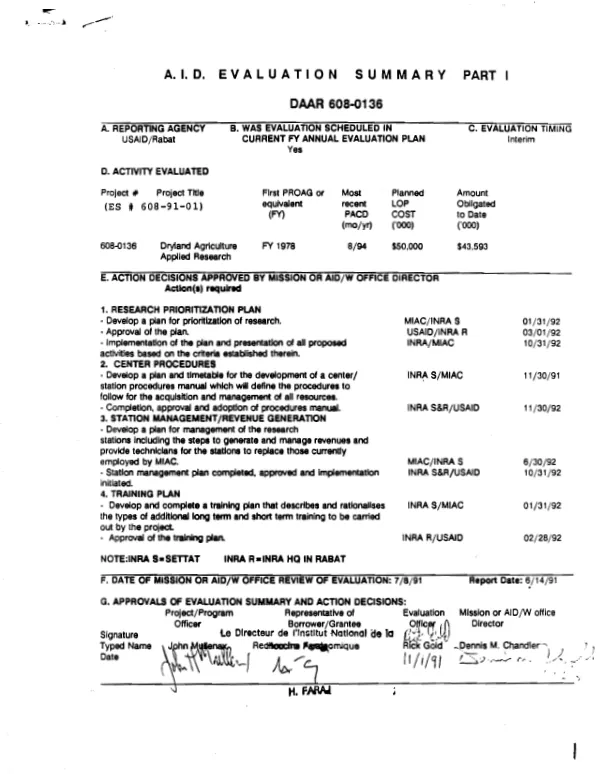
Morocco dryland agriculture applied research, project no. 608-0136 : mid-term evaluation
Sign inCHEMONICS INTERNATIONAL, INC.
Morocco dryland agriculture applied research, project no. 608-0136 : mid-term evaluation
Evaluates a project to establish a sustainable applied dryland farming research and technology transfer capacity at Morocco's National Agricultural Research Institute (INRA).
Eriksen, John H.|Brusberg, Frederick E. · 1991
Sign in to readA free account is required to download.
Abstract
Interim evaluation covers the period 1988-5/91. The project has made substantial progress toward achieving several of the targets established in the 1988 amendment. In particular, the INRA regional center near Settat is nearing completion, and four satellite field research stations are in operation. Participant training of Moroccan agricultural scientists is a clear success. To date, 9 M.S. and 11 Ph.D. candidates have received their degrees, 13 (4 M.S., 6 Ph.D.) are working on their theses in Settat, 19 (2 M.S., 14 Ph.D.) are still studying in the United States, and the remaining 4 (2 M.S., 2 Ph.D.) will begin training in 1991. In addition, scores of people have received short-term training. Returned Moroccan researchers have helped INRA to develop technologies which may have important impacts, e.g., new cereal and legume varieties (including insect- and pest-resistant varieties), improved planting and weed control practices, recommendations for timing and quantity of fertilizer applications, and the use of no-till soil cultivation methods. Two areas require corrective action. (1) There is a conflict between the project mandate to serve only small and medium dryland farmers and INRA's mandate to serve the needs of all farmers in its zone of influence. This has made it difficult to establish research priorities and allocate resources accordingly. Many activities have ignored the project mandate, while other potentially fruitful areas for research and extension have been neglected. The contractor's confused supplementary budget request to A.I.D. reflects this lack of priority setting and demonstrates the lack of management insistence that each project element contribute clearly to achieving the project's mission. (2) There is serious doubt about the sustainability of many of the project's activities. To sustain center operations, INRA will have to increase its operating budget by over 70% over the next 2 years and a further 42% in 1994. Additionally, INRA/Settat has significant problems in handling its increasingly scarce resources.