USAID. MISSION TO MOROCCO
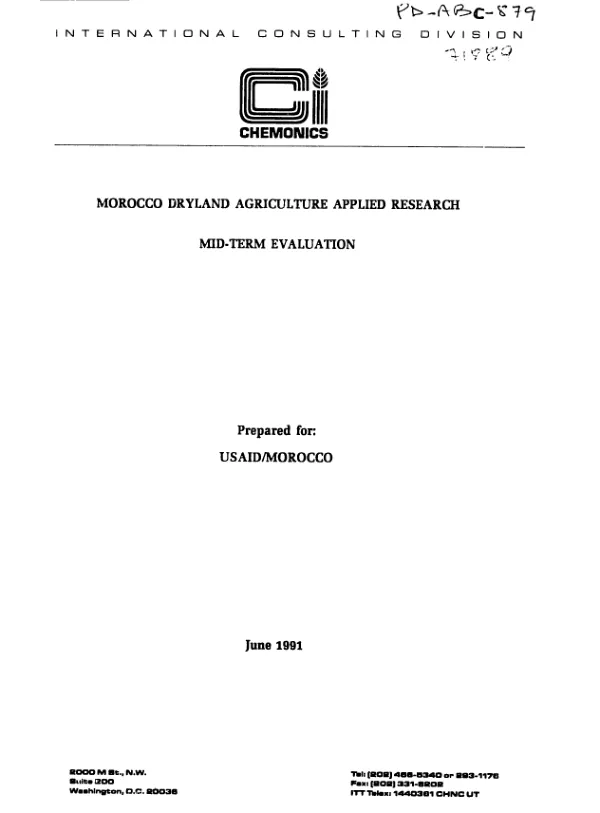
Mid-project evaluation report : dryland agriculture applied research
Evaluates project to develop an applied dryland agricultural research program in Morocco.
Furtick, W. R.|Voth, Leland|Morton, Alice L. · 1983
Sign in to readA free account is required to download.
Abstract
Special evaluation covers the period 6/78-5/83 and is based on document review, site visits, and interviews with A.I.D., Government of Morocco (GOM), contractor, and other-donor personnel. Despite a slow start due to delays in the arrival of TA staff, in the selection of participants for U.S. training, and in the construction of the National Agronomic Research Institute's Aridoculture Center (AC) (funded by the GOM), the project has made substantial progress. All but 3 of 25 participant trainees (15 Doctoral and 10 Master's candidates) are either studying in the U.S. or are receiving language training in Morocco before departure. Despite an unbroken 3-year drought which limited yield data, agronomic field experiments conducted (1981-82, 1982-83) at three satellite stations and farms throughout the region showed the potential for moisture storage in deeper soils and the value of certain production methods: e.g., the proper timing of herbicides for weed control; wider row spacing using grain drills at lower seeding rates; and the proper use of fertilizers. Also, work on developing new cereal varieties (3 barley, 2 durum and 1 bread wheat) is progressing. Socioeconomic studies implemented by the Ministry of Agriculture in Haute Chaouia have included: Master's theses on soil classification, food consumption, farm size, etc.; and a 51-farm sample survey. Although AC constructon at Settat is nearing completion, staff housing is inadequate and the suitability of the site for long-term agricultural research is doubtful (i.e., too small; soil not uniform). Other problems include: inadequate GOM funding resulting in limited staffing; an overly ambitious project design in terms of time and resources; equipment more suitable for farming than research; and inadequate transportation and GOM per diem for travel. Key recommendations are to increase funding for TA, participant training, commodity procurement, and socioeconomic research and and to extend the life of project.
Related documents