PLAN INTERNATIONAL
MOROCCO RFS-SSE MIDLINE 1 REPORT
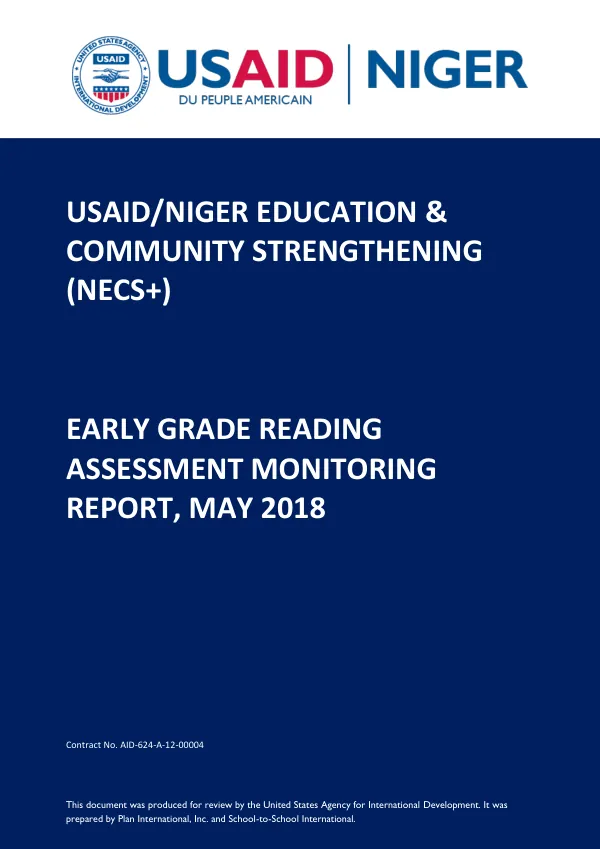
Early Grade Reading Assessment Monitoring Report, May 2018, was produced for review by the United States Agency for International Development.
2018 · 74 pages
Sign in to readA free account is required to download.
Abstract
It was prepared by Plan International, Inc. and School-to-School International. The report was contracted under Order No. AID-624-A-12-00004. The Niger Education and Community Strengthening (NECS+) activity aimed to improve early grade reading outcomes in Niger. The activity focused on the Zarma, Hausa, Kanuri, and Fulfulde languages. The report presents the findings of the Early Grade Reading Assessment (EGRA) monitoring, which was conducted in May 2018. The EGRA tool was used to assess the reading skills of students in grades 1 and 2. The tool consisted of several subtasks, including alphabet, word recognition, and reading comprehension. The assessment was administered to a sample of students in each language group. The results were analyzed to determine the reading proficiency of students in each grade and language group. The report presents the EGRA results for each language group, including the Zarma, Hausa, Kanuri, and Fulfulde languages. The results are presented by grade and gender. The report also compares the EGRA results to the Ministry of Education and Professional Examinations (MEP)-approved benchmarks. The results show that the reading proficiency of students in grades 1 and 2 varies across language groups. In general, students in grade 1 performed better than students in grade 2. The results also indicate that girls performed better than boys in some language groups. The report concludes that the EGRA results provide valuable information for improving early grade reading outcomes in Niger. The results can be used to inform the development of reading materials, teacher training programs, and other interventions aimed at improving reading proficiency. The report includes several annexes, including a reliability analysis of the EGRA subtask items, assessor agreement during training, weighting, summary of EGRA tool changes, and language-specific tables. The report also includes a list of tables and figures. The EGRA results for the Zarma language group show that students in grade 1 performed better than students in grade 2. The results also indicate that girls performed better than boys in some subtasks. The EGRA results for the Hausa language group show that students in grade 1 performed better than students in grade 2. The results also indicate that girls performed better than boys in some subtasks.
Related documents