CREATIVE ASSOCIATES INTERNATIONAL INC.
Quarterly Performance Report: October – December 2023
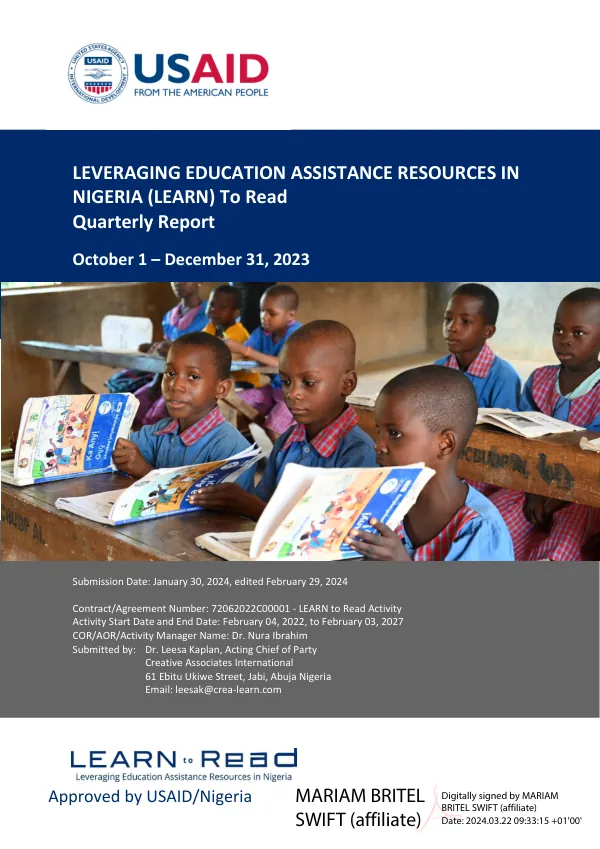
Leveraging Education Assistance Resources in Nigeria (LEARN) to Read is a five-year technical assistance Activity funded by the U.S.
2023 · 17 pages
Sign in to readA free account is required to download.
Abstract
Agency for International Development (USAID/Nigeria). The Activity supports federal and state governments to effectively utilize their available operational and technical resources to strengthen, scale, and sustain improvements in early grade reading (EGR) outcomes for pupils in Primary 1 and 2 (P1 and P2). LEARN is implemented closely with the federal government through the Federal Ministry of Education and its agencies. At the state-level, including Bauchi and Sokoto (designated as Legacy states), Adamawa (designated as Launching state), and other states (designated as On-Demand states), LEARN collaborates with state ministries of education and agencies to achieve the program's objectives. The program's primary goal is to ensure that all pupils in primary one and two in Legacy States meet minimum proficiency standards in reading. Additionally, pupils in primary one to two in the Launching State are expected to demonstrate improved reading outcomes in languages they use and understand. Furthermore, the program aims to support the Federal Republic of Nigeria in implementing an evidence-informed national strategy for EGR reform. To achieve these objectives, LEARN provides technical assistance to state governments, including capacity building, policy support, and monitoring and evaluation. LEARN's technical assistance approach is two-pronged, focusing on both state-level and school-level interventions. At the state level, the program works with state governments to develop and implement policies and strategies to improve EGR outcomes. This includes providing technical assistance to state ministries of education, developing state education strategic operational plans, and supporting the development of teaching and learning materials. At the school level, LEARN works with schools to improve reading outcomes through teacher training, provision of teaching and learning materials, and monitoring and evaluation. During the reporting period of October to December 2023, LEARN made significant progress in achieving its objectives. In Bauchi State, LEARN supported the development of a state education strategic operational plan, which outlines strategies to improve EGR outcomes. In Sokoto State, LEARN provided technical assistance to the state ministry of education to develop a policy on EGR. In Adamawa State, LEARN worked with schools to improve reading outcomes through teacher training and provision of teaching and learning materials. LEARN also made progress in implementing its monitoring and evaluation framework, which includes regular assessments of EGR outcomes, teacher training, and provision of teaching and learning materials. The program's monitoring and evaluation framework is designed to track progress towards its objectives and identify areas for improvement. During the reporting period, LEARN conducted regular assessments of EGR outcomes in Bauchi, Sokoto, and Adamawa states, which showed significant improvements in reading outcomes. In addition to its technical assistance activities, LEARN also engaged in policy and governance support, stakeholder participation, and management and administrative issues. The program worked closely with state governments, civil society organizations, and other stakeholders to ensure that its activities were aligned with national and state-level policies and strategies. LEARN also engaged in regular stakeholder participation and involvement, including work planning sessions with state governments and other stakeholders. Overall, LEARN made significant progress in achieving its objectives during the reporting period of October to December 2023. The program's technical assistance approach, monitoring and evaluation framework, and policy and governance support activities have contributed to significant improvements in EGR outcomes in Bauchi, Sokoto, and Adamawa states.
Related documents