USAID DEC
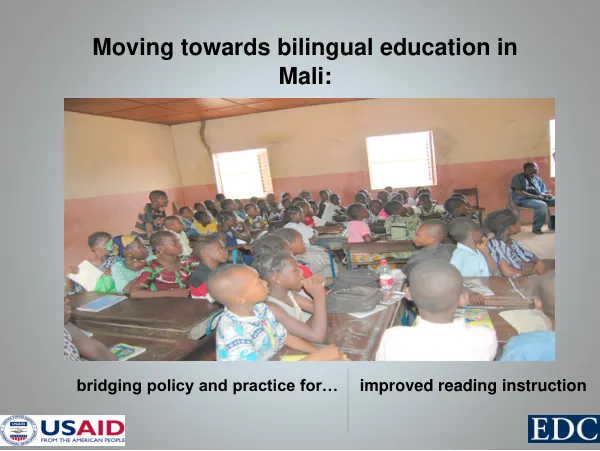
Moving towards bilingual education in Mali: bridging policy and practice for improved reading instruction
Sign inUSAID DEC
Moving towards bilingual education in Mali: bridging policy and practice for improved reading instruction
The agricultural development initiative in Mali began with a focus on improving reading instruction and moving towards bilingual education.
28 pages
Sign in to readA free account is required to download.
Abstract
The Ministry of Education, Literacy, and National Languages (MEALN) in Mali established a planning and statistics unit, a unit for support to decentralization, directorates of pedagogy, and a directorate of basic education to oversee the implementation of bilingual education. A favorable policy environment was established in Mali, with the introduction of bilingual instruction in 13 languages by 1999 and its expansion to 2,550 public schools by 2005. The goal was to have all Malian schools offering bilingual instruction by 2009-2010. To achieve this, a study was conducted to examine the feasibility of implementing bilingual education in the administrative region of Mopti. The study aimed to establish a linguistic mapping for the region, examine the material available for teaching the bilingual curriculum, and determine whether teachers were trained to teach the bilingual curriculum. The study also evaluated the degree of implementation of the bilingual curriculum in schools and developed recommendations to support its implementation. The study objectives included creating a languages map with precision to a certain geographic area of a country and tailoring instruction to a child's mother tongue. The study's assumptions were brought into question, including the concept of a majority language and a common language. The study also explored the relationship between a teacher's mother tongue and language best spoken by that teacher, as well as the teaching of the national language and instruction of the national language. The study sample included 949 schools, 2846 teachers, and 949 focus groups with primary school students in the administrative region of Mopti. The study found that in 68% of the region's schools, the children speak the same language, making it easier to determine the language of instruction. However, in the remaining 32% of schools, the language the children use in common should be the language of instruction. The study's findings have implications for the implementation of bilingual education in Mali and highlight the need for a more nuanced understanding of language use in the region.