RTI INTERNATIONAL
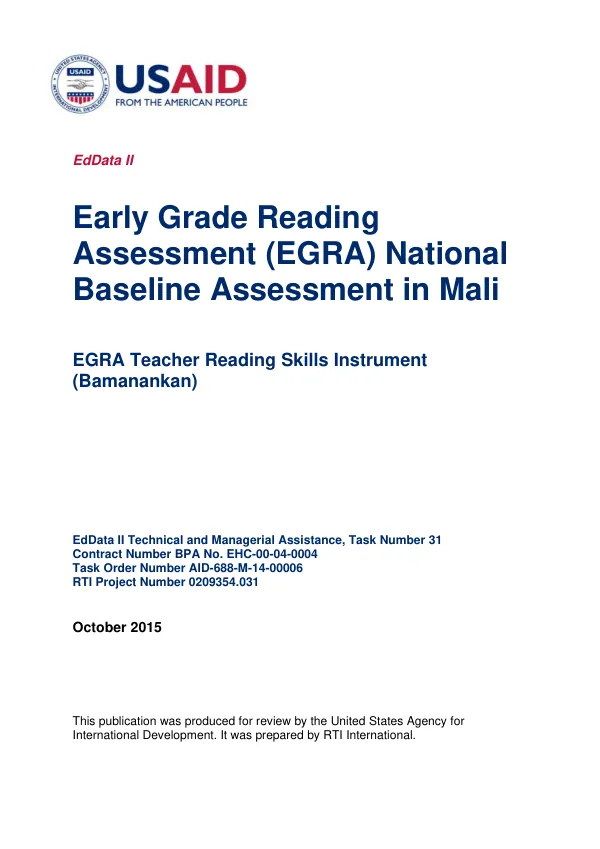
Early Grade Reading Assessment (EGRA) National Baseline Assessment in Mali
The Early Grade Reading Assessment (EGRA) Teacher Reading Skills Instrument in Bamanankan was developed for use in Mali as part of the EdData II project.
2015 · 6 pages
Sign in to readA free account is required to download.
Abstract
The instrument is designed to assess the reading skills of teachers in Bamanankan, the local language, and to provide a basis for improving reading instruction in early grade classrooms. The instrument consists of a text to be read aloud by the teacher, followed by a series of questions to assess the teacher's reading skills. The text is written in Bamanankan and is intended to be read at a level that is challenging for early grade students. The questions that follow the text are designed to assess the teacher's ability to read accurately, fluently, and with comprehension. The instrument includes a section for recording the teacher's reading time, as well as a section for noting any difficulties the teacher may have with reading in Bamanankan. The instrument also includes a section for assessing the teacher's ability to answer questions about the text, including questions about the plot, characters, and themes. The instrument is designed to be used with teachers in grades 2 and 4, and is intended to provide a basis for improving reading instruction in early grade classrooms. The instrument is also intended to provide a way to assess the reading skills of teachers in Bamanankan, and to identify areas where teachers may need additional support or training. The instrument includes a series of questions that are designed to assess the teacher's ability to read accurately, fluently, and with comprehension. The questions include items such as: * Can the teacher read the text accurately, including words that are difficult to pronounce? * Can the teacher read the text fluently, without hesitation or stumbling? * Can the teacher answer questions about the plot, characters, and themes of the text? * Can the teacher use the text to make inferences and draw conclusions? The instrument is an important tool for improving reading instruction in early grade classrooms in Mali, and can be used to assess the reading skills of teachers in Bamanankan. The instrument can also be used to identify areas where teachers may need additional support or training, and to provide a basis for developing targeted interventions to improve reading instruction. The instrument is part of a larger effort to improve reading instruction in early grade classrooms in Mali, and is intended to be used in conjunction with other assessments and interventions to improve reading outcomes for students. The instrument is an important tool for educators and policymakers in Mali, and can be used to inform decisions about how to improve reading instruction in early grade classrooms.