USAID. MISSION TO MOZAMBIQUE
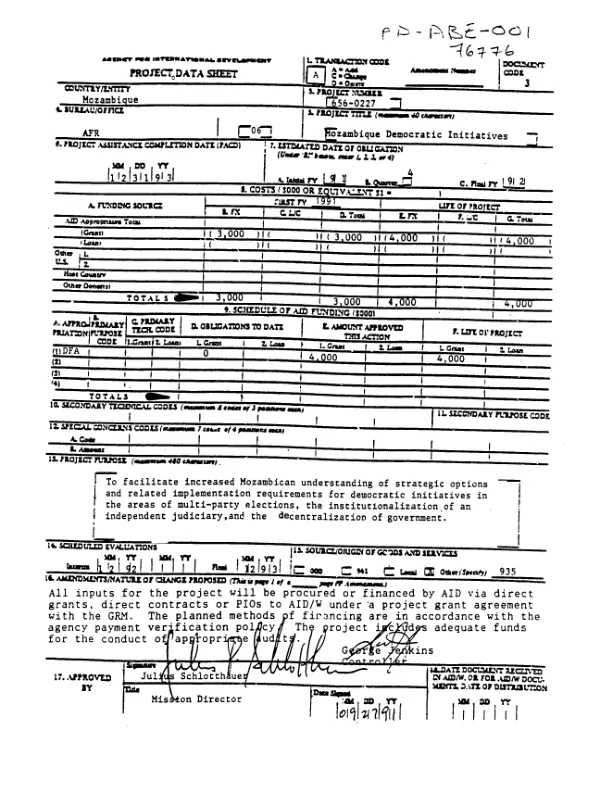
Mozambique democratic initiatives
Project to promote democracy in Mozambique through support for free elections, decentralization of government, and creation of an independent judiciary.
1991
Sign in to readA free account is required to download.
Abstract
Electoral support will be provided by the International Foundation for Electoral Systems and will be in two phases. (1) An election planning needs assessment, comprising TA as well as study tours to the United States and other democratic nations, will help to define a general election strategy. Specifically, assistance will describe alternate electoral models and explain their operation; examine various aspects of Mozambique"s civil society and political culture and relate them to competing electoral models; and present a set of workable alternatives. (2) After a general election strategy has been defined, an election action plan will be developed to implement the strategy. TA will be provided to develop an institutional framework for elections; develop a model for a nonpartisan electoral commission; determine the roles of central, provincial, and local authorities in the electoral process; assess public information and staff training needs; and develop a budget. Assistance in holding an election, e.g., by providing informational materials or training administrative personnel, is not currently contemplated. To promote decentralization of governmental authority, the project will conduct a sector survey to assess the functions and roles of each level of government and examine how bureaucratic structures could better support a democratic polity. A multidisciplinary team will, inter alia, analyze relations between each level of government and suggest appropriate degrees of decentralization; define TA and training needs for local administration; describe working models of governance systems in other nations; and review public finance structures. Following the sector survey, an action plan that incorporates the above recommendations will be developed. Assistance to promote a strong and independent judiciary will be provided in two phases by a team of lawyers. The first phase will be a legal sector survey to assess the relationship between the executive branch and judiciary; analyze the legal system"s structure and recommend revisions; examine the constitution and existing legislation and recommend changes to strengthen specific rights; and conduct a training needs assessment for judges, other members of the judiciary, and paralegals, and develop a budget and implementation plan for interventions such as study trips, internships, and seminars. In the second phase, TA will be provided to develop an action plan for (1) legal education, including legal aid, public awareness programs, and lawyer training; and (2) legal reform, including identifying laws that need to be drafted or amended, developing an implementation schedule and budget for legislative reform, and providing models for drafting and revising legislation. A small amount of funds will be set aside for TA to NGOs for activities to support development of a civil society and a nongovernmental base for democracy. NGOs will also receive support for activities under the three main project components. Amendment of 8/20/93 increases funding, extends the PACD 2 years to 12/96, waives the requirement that project-produced civic education materials be marked with the A.I.D. emblem (which could lead to adverse voter reactions), and broadens the project purpose to permit support for the actual implementation of multi-party elections, which are scheduled for 10/94. Funds provided through this amendment will be used to finance a national civic education campaign, election officer training, and logistical air transportation. Other new activities will include: (1) establishing a Center for Judicial Education in the Ministry of Justice; (2) research and workshops on enhancing the roles of traditional authorities (to be implemented by the African-American Institute); and (3) reduced emphasis on promoting civil society through grants to NGOs (most of which lack adequate financial systems for grant management), with more emphasis on popular education (to be implemented by Catholic Relief Services/Caritas). (PD-ABJ-534)
Related documents
![Democratic and civic institution development [: amendment no. 1]](https://covers.devme.ai/gen/13449.webp)