USAID DEC
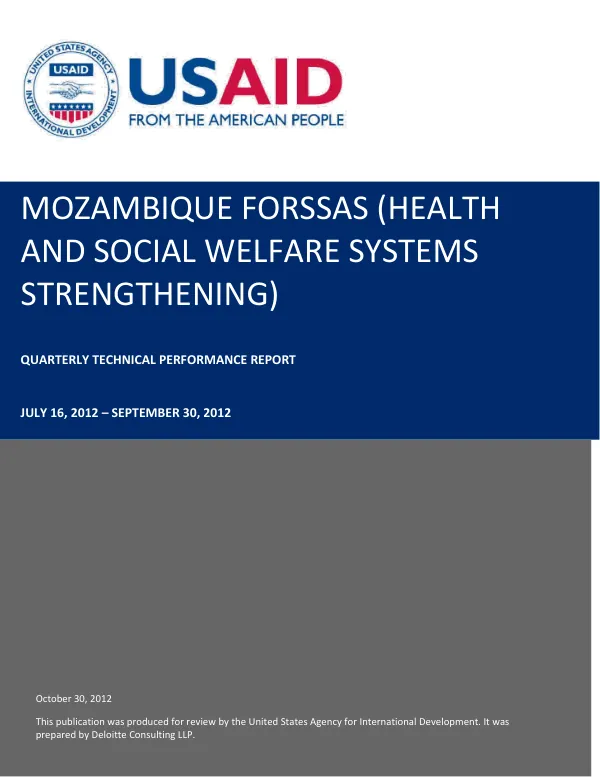
Mozambique Health and Social Welfare Systems Strengthening Program Quarterly Technical Performance Report
Sign inDELOITTE CONSULTING, LLP
Mozambique Health and Social Welfare Systems Strengthening Program Quarterly Technical Performance Report
The Mozambique Health and Social Welfare Systems Strengthening Program (HSWSS-FORSSAS) aims to strengthen Mozambique's supporting health systems related to Governance, Health Financing, Sustainable Operations Capacity, and Human Resources for Health.
2012 · 11 pages
Sign in to readA free account is required to download.
Abstract
The program, led by Deloitte Consulting LLP, was awarded a five-year USAID project in July 2012. The key result areas for HSWSS-FORSSAS include increased effectiveness in health governance, improved health public financial management, improved skills and knowledge in finance, governance, and human resource management, and strengthened institutional capacity to plan, distribute, retain, and train health managers, community health workers, and social workers. The program's initial efforts focused on project start-up, including the hire of 13 key staff members, administrative systems development, and staff training. Concrete technical results were largely achieved where HSWSS-FORSSAS had existing staff in place. Key impacts focused on integration of external donor projects and corresponding management requirements within national system mechanisms. Other outcomes include stronger institutional knowledge and capacity for the Ministry of Health in monitoring and evaluation, financial management, and procurement and supply chain. Fifty-five students continued their second semester at the Instituto de Ciências de Saúde de Maputo (ICSM) as part of the Social Welfare Technicians (Level Five) and Early Childhood Educators (Level Three) certification program, which is scheduled to be completed in December 2012. The program also provided technical assistance for the operations at the Global Fund Unit, now belonging to the Department of Projects inside the Directorate of Planning and Cooperation. The program's progress is reported in four intermediate results: Increased Effectiveness in Health Governance, Improved Management of Health Sector Financing, Strengthened Management & Operations Capacity, and Strengthened Institutional Capacity to Improve the Management, Budgeting, and Performance of Key Health and Social Welfare Staff. Each intermediate result is described in terms of current and cumulative progress, challenges encountered and solutions, and plans for the upcoming quarter. In terms of governance, the program has made progress in improving planning management and budget execution. The Ministry of Health has developed a Health Sector Monitoring and Evaluation Plan, and the program has provided technical assistance to the Ministry of Health to improve its financial management and procurement and supply chain systems. The program has also provided training to health managers and community health workers on financial management and procurement and supply chain systems. In terms of finance, the program has made progress in improving health public financial management. The Ministry of Health has developed a financial management system, and the program has provided technical assistance to the Ministry of Health to improve its financial management and procurement and supply chain systems. The program has also provided training to health managers and community health workers on financial management and procurement and supply chain systems. In terms of sustainable operations capacity, the program has made progress in improving skills, knowledge, and tools in finance, governance, and human resource management. The program has provided training to health managers and community health workers on financial management, procurement and supply chain systems, and human resource management. The program has also provided technical assistance to the Ministry of Health to improve its financial management and procurement and supply chain systems. In terms of strengthened institutional capacity, the program has made progress in strengthening the institutional capacity of the Ministry of Health to plan, distribute, retain, and train health managers, community health workers, and social workers. The program has provided training to health managers and community health workers on financial management, procurement and supply chain systems, and human resource management. The program has also provided technical assistance to the Ministry of Health to improve its financial management and procurement and supply chain systems. The program's progress is also reported in terms of performance monitoring, challenges encountered, and plans for the upcoming quarter. The program has made progress in monitoring and evaluation, financial management, and procurement and supply chain systems. The program has also provided training to health managers and community health workers on financial management, procurement and supply chain systems, and human resource management. The program's challenges include the need to improve the capacity of the Ministry of Health to manage health sector financing, improve the skills and knowledge of health managers and community health workers, and strengthen the institutional capacity of the Ministry of Health to plan, distribute, retain, and train health managers, community health workers, and social workers. The program's plans for the upcoming quarter include continuing to provide technical assistance to the Ministry of Health to improve its financial management and procurement and supply chain systems, providing training to health managers and community health workers on financial management, procurement and supply chain systems, and human resource management, and strengthening the institutional capacity of the Ministry of Health to plan, distribute, retain, and train health managers, community health workers, and social workers.