ABT ASSOCIATES, INC.
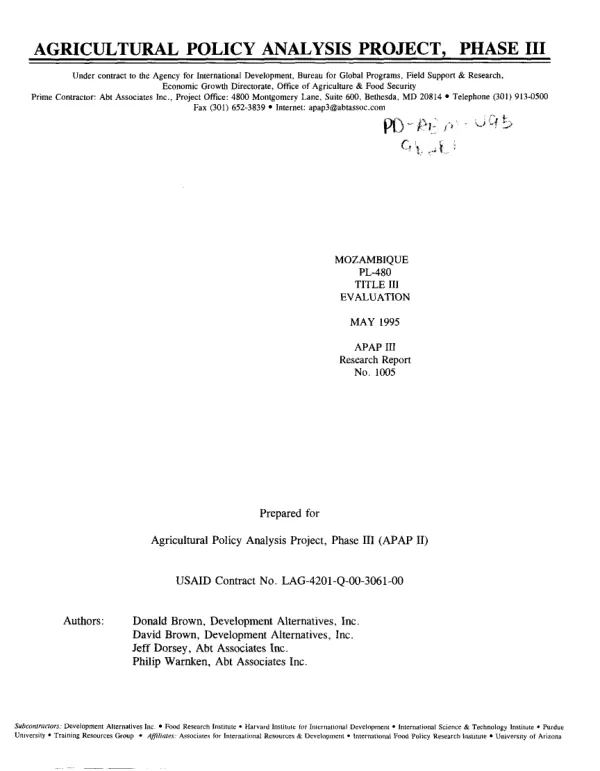
Mozambique : PL-480 Title III -- evaluation
Evaluates the P.L.480 Title III program to improve the effectiveness and efficiency of the Government of Mozambique's (GRM) food safety net security program through commercial food aid tied to policy conditions.
Brown, Donald|Dorsey, Jeff · 1995
Sign in to readA free account is required to download.
Abstract
Evaluation covers the period 4/1/91-5/95. The Title III program provided needed maize to people in Mozambique at a time when food production levels were insufficient to meet food security requirements. By keeping food prices low in the marketplace, the program provided an income transfer to low-income people; this was the real food safety net. The program also contributed significantly to increased competition in the food market, resulting in greater market efficiency. Except for the import parity price (IPP), all policy indicators have been met in substance. Progress has been made in reaching the IPP for maize. Since 1991, changes have occurred in Mozambique that now make achievement of food self-reliance possible. However, the program was not without shortcomings. These included serious quality problems with the maize (although an upgrading of standards has solved this problem), and the fact that the consignees' financial discipline and accountability is much better than that of the Government (GRM). The delivery schedule for Title III arrivals is a pivotal problem; clustered deliveries can cause oversupplied markets, difficulty for receivers, wastage, and instability in the market, and can ultimately discourage local production. Improved information on Title III deliveries can help to alleviate some negative side effects of clustered deliveries. In addition, the GRM has not been as helpful as it should be in providing information to potential consignees. The consignee selection process managed by the Ministry of Commerce for the GRM is now neither as transparent nor as effective as it has been and should be. The Ministry has moved away from the established pre-qualification system that had been in place. The basic overall recommendation is that USAID begin planning for a well-managed draw-down of the Title III program over the next 5-6 years. Management of this draw-down is critical. Too rapid a reduction could lead to food shortages and resultant economic and political instability. Too large a Title III program, on the other hand, could hinder expansion of local food production and eventual achievement of food self-reliance. At the policy level, USAID, in coordination with other donors, should press the GRM to continue moving toward IPP of commercial food aid. Two new policy areas for the Title III program are suggested: (1) revision of the financial relationship among the consignees, the GRM, and the special account; and (2) incorporation of the DANIDA-funded program of management and technical assistance to the port into the overall privatization scheme. (Author abstract, modified)
Related documents