USAID. BUR. FOR POLICY AND PROGRAM COORDINATION. CENTER FOR DEVELOPMENT INFORMATION AND EVALUATION (CDIE)
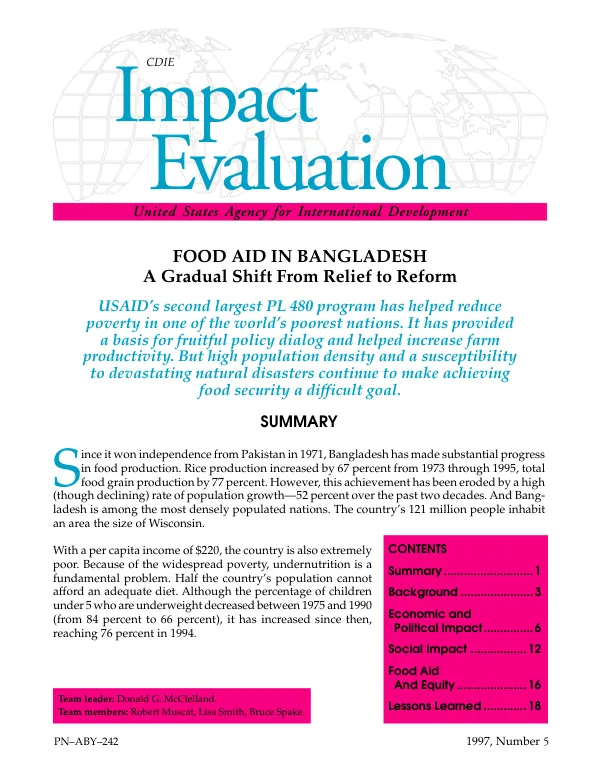
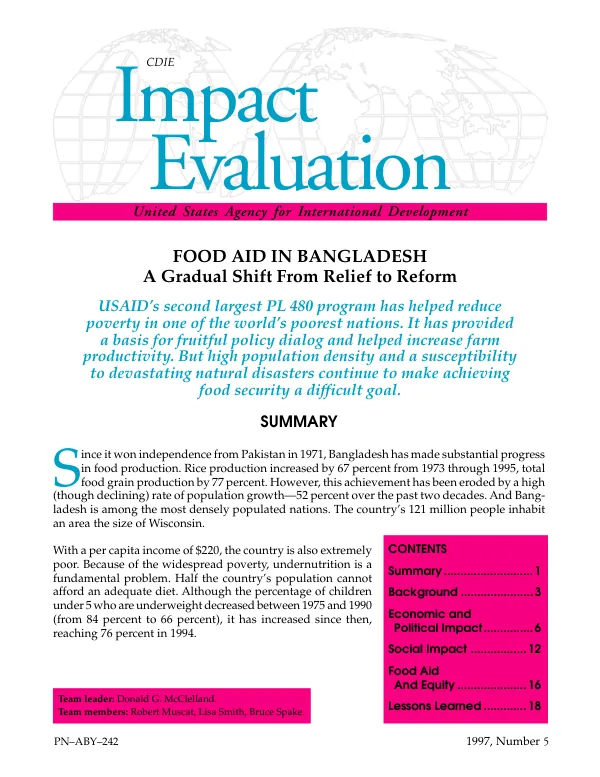
Food aid in Bangladesh : a gradual shift from relief to reform
The P.L.
McClelland, Donald G.; Muscat, Robert · 1970
Sign in to readA free account is required to download.
Abstract
480 program in Bangladesh, the second largest in the Agency, has been the country"s largest source of food aid since its independence from Pakistan, providing over $2.3 billion of food from 1972 through 1994, about 41% of the total amount of food that Bangladesh received in that period. Of this amount, 71% was program food aid (mainly Title III); much of the rest was project food aid (Title II) that supported what grew to become one of the largest food-for-work (FFW) efforts in the world. This report assesses the economic, political, and social effects of the program and identifies its beneficiaries. The multi-year Title III program has focused on promoting food security through policy reform. Specific reforms have included targeting the country"s food distribution system more closely on the poor and providing production incentives to farmers by stabilizing food price fluctuations within a relatively narrow range. Of the Title II FFW programs, road construction has been the mainstay. The impact of this assistance has been substantial. Since the mid-1980s, the feared food grain gap has diminished, thanks in part to the policy reforms supported by the program and first-class monitoring by USAID and the World Bank. Equally importantly, food aid represented a significant resource for a country suffering severe shortages in virtually all resources. P.L. 480 was especially critical from independence in 1971 to 1987, when it equaled more than 10% of the country"s export earnings. U.S. food aid also contributed to the sharp decline, from 92% in 1974 to 48% in 1992, in the incidence of poverty in Bangladesh. The program has provided seasonal employment to landless laborers under a CARE-administered FFW program; developed much of the country"s rural roads network, thereby increasing both agricultural and off-farm incomes as well as access to family planning and health services and primary schools; and financed agricultural research that contributed to major productivity gains in agriculture and a 47% reduction in real rice prices from 1975 to 1994. Food aid has also improved food consumption, though it is difficult to demonstrate any significant impact on children"s nutritional status. Finally, the program has clearly benefitted the poor by supporting reforms that redirected subsidized public food distribution to them, by implementing FFW efforts in relatively poor geographic regions, and by supplying a food commodity -- wheat -- which tends to be bought by the poor rather than by the rich. The Bangladesh experience offers several important lessons. It demonstrates that food aid can provide the basis for policy dialogue on issues critical to achieving food security. That is partly because it reduces the risk of undertaking politically sensitive changes in food policy. It confirms that sound policy analysis is fundamental to successful policy reform. It illustrates how food aid can be successfully targeted not only to reach the poor, but also to avoid reaching the rich. It also shows how food aid and the local currency generated from the sale of food can be used to support public sector activities needed to boost food production, improve access to social services, and reduce poverty. Although food aid is a relatively inefficient vehicle for funding activities that require cash, this is a moot point when such aid is the only resource available. Although in theory FFW projects can achieve short-term relief and long-term development simultaneously, this rarely occurs in practice. Finally, although food aid can discourage domestic grain production, policy changes associated with food aid can enhance production -- more than offsetting the minimally depressing effects of the imports.
Related documents