ABT ASSOCIATES, INC.
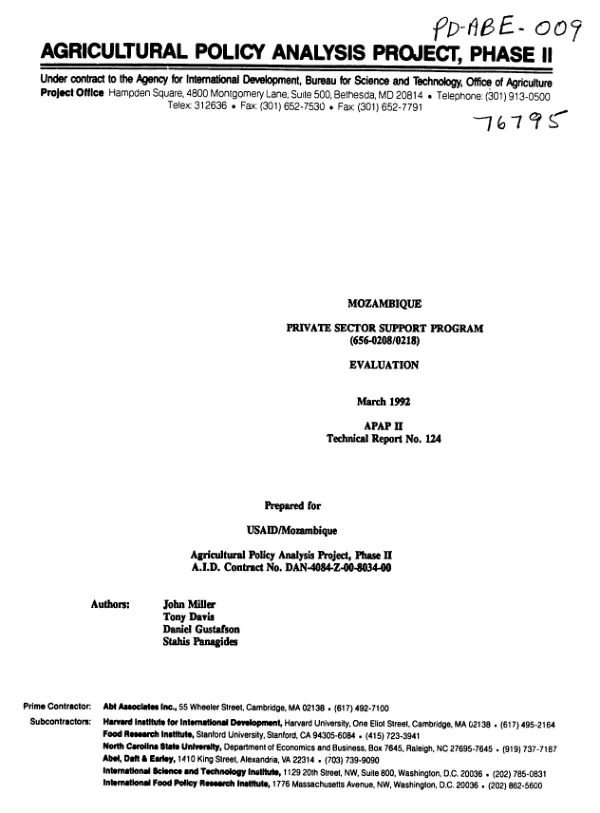
Mozambique : private sector support program (656-0208/0218) -- evaluation
Interim evaluation of a commodity import program (CIP) to promote food and agriculture policy reform in Mozambique.
Miller, John|Davis, Tony · 1992
Sign in to readA free account is required to download.
Abstract
Complementary TA is also provided. The evaluation covers the period FY89- 12/91. The Government of Mozambique (GOM) has met virtually all policy reform targets. The program is well-conceived and has realistic policy objectives. However, the inclusion of petroleum in the policy agenda and in CIP eligibility, while in response to a GOM request under special circumstances, diluted the focus on the agricultural sector. Agricultural price policy reforms have been successful in eliminating the fixed price system, and removing the illegality of selling above the GOM price. The new floor price system serves the function of a reference price rather than as a true government price support. There is evidence that producers have responded positively to the price incentives, although the removal of price restrictions on inputs and consumer goods has meant that overall producer terms of trade may have worsened in the short run. USAID/M has correctly emphasized the need for more rapid divestiture of state farms. Divestitures so far have not reflected the application of a coherent plan or process, and transfer of land ownership to the private sector is still not allowed. The current GOM priority appears to be to reduce the budget drain caused by state farms, rather than to increase productivity by putting land in the hands of private producers. Private sector growth has been stimulated by allowing private agents to import all agricultural commodities procured through the CIP. Progress has also been made in deregulating commercial transactions to strengthen private marketing channels. The program has been successful in supporting the introduction and use of the secondary market for foreign exchange and has played a useful role in assessing alternative market-based allocation mechanisms. USAID/M is to be commended for adhering to market-based principles in the pricing and allocation of foreign exchange and for being suitably cautious in not joining the System for the Non-Administrative Allocation of Foreign Exchange. TA activities have evolved from monitoring to capacity building and policy implementation support. TA now in place through resident specialists, short-term support, research, and training is already making an important contribution, for example, by providing market information that has been useful in improving policy decisions. However, the GOM is an unequal partner, lacking the quantitative and qualitative policy and technical capacity to develop its own strategy. The full impact of program reforms will only be felt over the long term. In addition to the ongoing civil war, numerous other obstacles impede the recovery and development of Mozambique's agricultural production and marketing systems. USAID/M should continue to support the monitoring of prices and other factors that influence agricultural production and marketing. USAID/M should also develop a new non-project assistance program that concentrates on implementing the policy decisions of the present program.