USAID DEC
Multisectoral approaches in promoting girls" education : lessons learned in five SAGE countries
Sign inACADEMY FOR EDUCATIONAL DEVELOPMENT, INC. (AED)
Multisectoral approaches in promoting girls" education : lessons learned in five SAGE countries
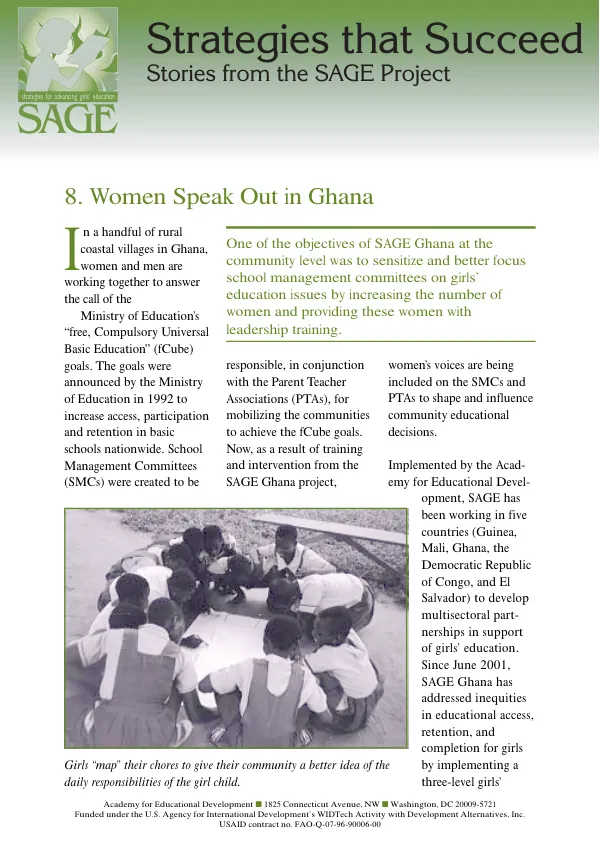
USAID"s Strategies for Advancing Girls" Education (SAGE) (3/99-7/02) aimed to mobilize broad-based, multisectoral constituencies to improve the educational participation of girls.
Rugh, Andrea · 2002
Sign in to readA free account is required to download.
Abstract
Five countries participated in SAGE: Guinea, Mali, Ghana, El Salvador, and the Democratic Republic of the Congo. SAGE mobilized local partners and provided them with capacity-building technical services to support girls" education. SAGE also convened national and international conferences and conducted research studies to inform and document the contributions of "nontraditional" partners in supporting girls" education. This report summarizes the experiences and lessons learned in using this approach, with particular focus on the multisectoral model as it was originally envisioned by USAID and as it evolved into the implementation strategy used by SAGE in project countries. The country cases illustrate a variety of ways the approach can be implemented in terms of differing local rationales, partners, activities, results, and efforts to promote sustainability. The cases suggest specific lessons about implementation and present general conclusions about multisectoral strategies as tools in improving the conditions for girls" education. Finally, the report suggests some guidance and advice for making the best use of multisectoral approaches. Overall, SAGE countries showed clear evidence that their multisectoral strategies produced: (1) greater overall consciousness of girls" issues; (2) more and varied actors working on behalf of girls" education; and (3) more strategies addressing constraints on girls" participation. The countries modeled participatory processes that increased the capacity of local civil society organizations to solve these and other development problems. Their insistence on inclusionary practices gave women and girls more decisionmaking power over their own lives, thus encouraging changes that may prove even more significant over time. The bottom line from SAGE experience is that multiple sectors can be mobilized to act on behalf of girls" education, can overcome many of the constraints that prevent girls" participation, and can do so while relying mainly on their own resources. This SAGE evidence provides a strong mandate for using multisectoral approaches to address many of the complex issues of girls" education. (Author abstract, modified)