ACADEMY FOR EDUCATIONAL DEVELOPMENT, INC. (AED)
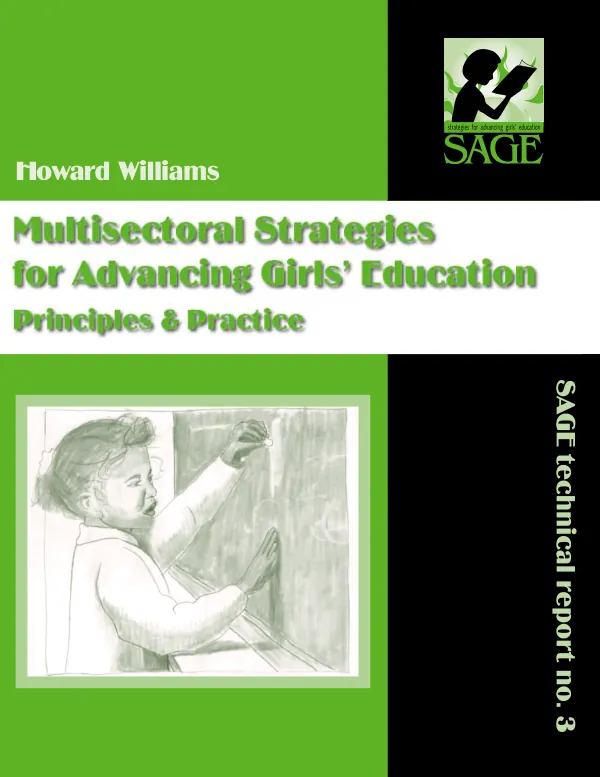
Multisectoral strategies for advancing girls" education : principles and practice
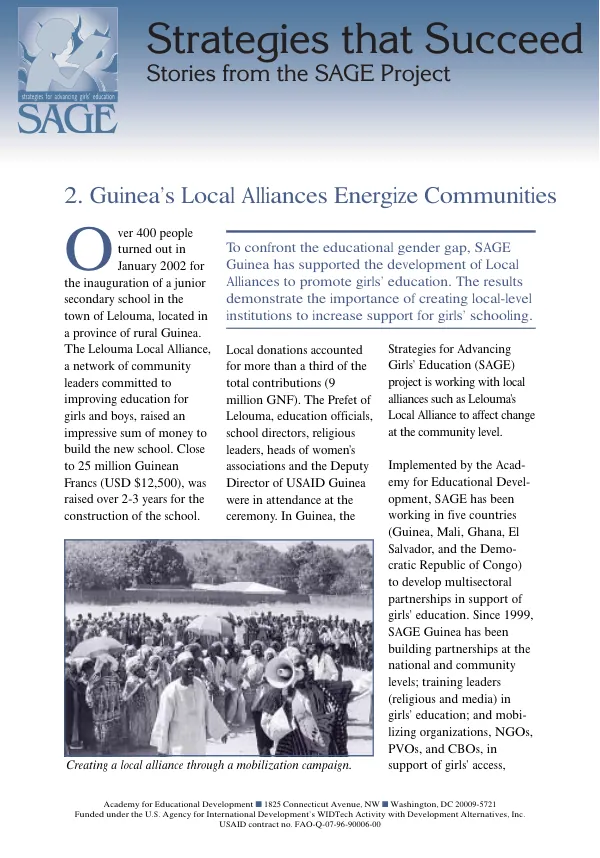
This study profiles the Strategies for Advancing Girls" Education [SAGE] program in Guinea and the Girls" Education Activity (GEA) in Morocco -- two USAID programs to advance girls" education via a multisectoral approach, i.e., one that enlists the support of non-traditional sectors (civil society organizations [CSOs], NGOs, the business community, the media, and religious organizations).
Williams, Howard · 2001
Sign in to readA free account is required to download.
Abstract
The two case studies have validated the six principles of USAID"s multisectoral approach to girls" education: (1) A multisectoral approach recognizes the importance of traditional and non-traditional partners in changing both the demand for and supply of girls" education. This principle has been accepted and validated by both governments. In addition, non-traditional partners have accepted new working relationships with government and other sectors, and all partners have demonstrated strengths to support girls" education. (Whether the partnerships can carry on and evolve as organizational entities in the absence of a project or "convening party" is yet to be documented.) (2-3) Solutions and programs are to be locally designed and employ a multi-method approach. (4) Local human, financial, and physical resources are to be developed to support girls" education. USAID"s multisectoral approach is based upon the premiss that many barriers to girls" education are more than the government can overcome. (5) The multisectoral approach to girls" education requires that many actors learn new information, adjust attitudes, and learn to work with colleagues from other sectors. Hence, capacity building has been a prominent feature of both projects and is a precondition for extending and sustaining the achievements already made. (6) Engaging all stakeholders in support of girls" education "democratizes" the civic, social, and economic opportunities for girls. Both country cases have demonstrated support by the national leadership and by elected and appointed officials while including and being informed by local-level actors and stakeholders. Media and sector leaders have raised the expectations for educating (and for educated) girls. Government has articulated its responsibilities and limitations and has opened itself up to new relationships with CSOs, NGOs, the private sector, religious organizations, and the media. In sum, USAID"s approach, as tested in Guinea and Morocco, offers a robust option for improving the education of girls. It also could serve as a model for providing other social services to marginalized populations in countries in which traditional sectors have reached the limits of their ability to service social demand. An aspect that may bear greater investigation is the degree to which government-provided education is stimulated to improved performance when engaged in non-traditional partnerships.