USAID. MISSION TO HONDURAS
Municipal development
Summarizes attached mid-term evaluation of a project to strengthen popular democratic processes in Honduras and improve municipal capabilities to respond to the needs of constituents.
1996
Sign in to readA free account is required to download.
Abstract
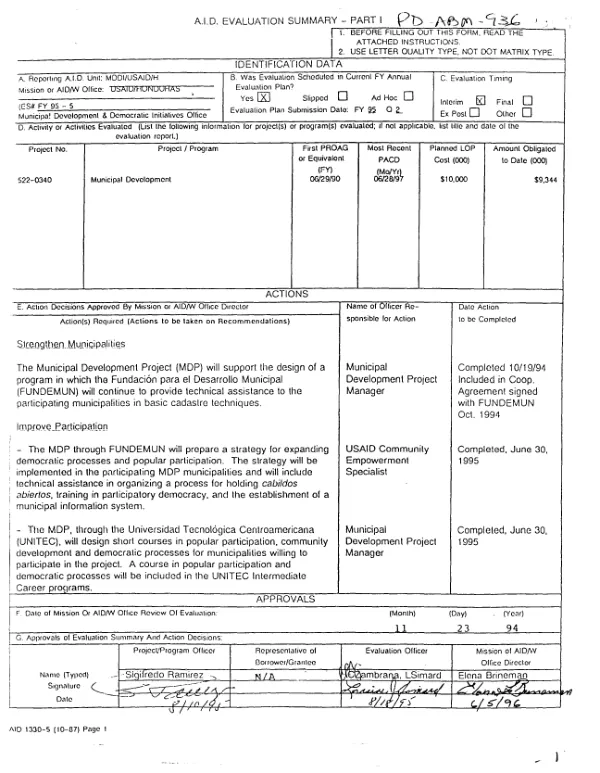
The evaluation covered the period 6/90-8/94 and employed the "fourth generation" methodology -- evaluating the project from the viewpoint of the stakeholders. The project is accomplishing its intended results in improving democratic processes and in strengthening municipalities, local participation, and intermediate organizations (NGOs). Stakeholders felt that the project"s components are appropriate and helpful; they wanted no component to be dropped, and many to be expanded. They also wanted to have the project"s life extended. In all, stakeholders made 66 specific recommendations. However, full implementation of these recommendations would cost much more money and take much more time than is available, even with the proposed $2 million 1-year PACD extension. Accomplishments include the following: local organized groups and Chambers of Commerce have participated in community projects; in the last election, communities for the first time could select their mayor rather than having him/her elected as part of a presidential slate; the project has strengthened the administration of municipalities and increased their awareness of community needs; adoption of formula-based revenue sharing through which municipalities are to receive funds from the central government; technical staff of municipalities are more capable of performing their jobs; cadastral systems were improved and tax revenues increased; the Asociacion de Municipalios de Honduras (AMHON) has emerged as an effective nonpartisan voice for the political agenda of municipalities and has developed a means of receiving funding from municipalities; training programs have been initiated that can lead to the professionalization of municipal administration; regional organizations have been formed by municipalities working together on common problems; and Fundacion para el Desarrollo Municipal (FUNDEMUN) has been created as a Honduran NGO with the capacity to provide TA to the municipalities. The municipalities that have been helped the most by the project are working with smaller ones nearby on TA and training programs. The Mission approved the evaluation, its participatory methodology, and its construction of a decision tree which reduced the 66 stakeholder recommendations to 22 and presented them in manageable form. The project team reviewed the recommendations, which revealed a concern for more communication and a need for greater emphasis on community participation, and accepted 9 for implementation, including development by the Universidad Tecnologica Centroamericana (UNITEC) of short courses in popular participation, community development, and democratic processes for participating municipalities. The only reservation expressed by the Mission was that the evaluation did not pay sufficient attention to the gender issues raised by the stakeholders. Lessons learned noted by the Mission are as follows. (1) Subjective and personal perceptions of project components can only be uncovered through a non-traditional methodology. (2) A well-developed information and communications systems is essential to keep a large number of project participants informed on implementation, objectives, resource use, and progress. (3) The development of democratic institutions and processes and the securing of widespread popular participation in those processes will take far longer than the absorption of new technical approaches to administration, finances etc., and will require much more time, effort, and resources if the processes are to have a lasting effect on society.
Related documents