USAID. MISSION TO PERU
Narcotics education and community initiatives
Project to stimulate national, action-oriented awareness in Peru of the dangers of drug production, trafficking, and use.
1992
Sign in to readA free account is required to download.
Abstract
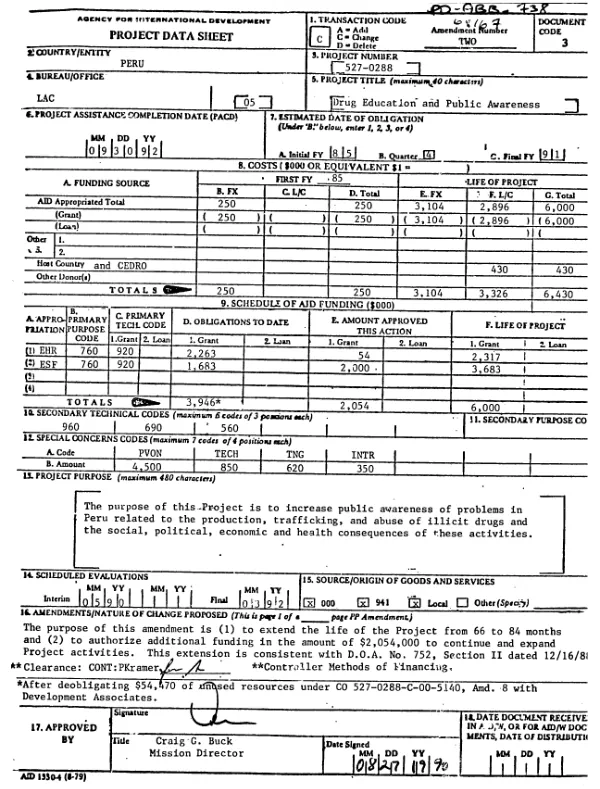
The project will: (1) strengthen the Center for Education and Information on Drug Abuse (CEDRO) as Peru"s leading drug information and education center; (2) expand drug-related curricula in secondary schools; (3) develop community drug prevention programs in high-risk areas; (4) and consolidate the Street Children program. CEDRO, the implementing agency, was established under predecessor Project 5270288. To consolidate its position, CEDRO will undertake the following: (1) disseminating information by developing anti-drug campaigns (book, newspapers, film, and video), gaining community participation in this effort, sponsoring workshops and conferences, and implementing public awareness activities in concert with its network of concerned community groups; (2) providing educational materials to schools, universities, entrepreneurs, prisoners, and community groups in general; (3) conducting drug abuse studies, including epidemiological studies, opinion surveys, and anthropological research; (4) training new CEDRO promoters to provide drug prevention training/TA to public and private institutions; and (5) supporting special programs for high-risk populations such as teenagers. In addition, CEDRO will develop a financial sustainability plan. The project will also support expansion of the Ministry of Education"s secondary school drug prevention program from the present 114 schools to no fewer than 1,800 by 1997. Emphasis will be put on schools in and near coca-growing regions. Third, community-designed drug prevention programs will be implemented in areas adjacent to coca growing regions. These efforts may be recreational, cultural, or entrepreneurial, and will include campaigns concerning the adverse environmental impacts of drug processing. Finally, the project will consolidate and extend CEDRO"s Street Children Program in Lima. The program -- which currently operates five shelters providing food, medical care, drug rehabilitation, social re-education, vocational training, and a family "reinsertion" program to children (aged up to 18) living on their own in the streets -- will be expanded to include: a child mistreatment/runaway prevention system; training/TA for other child care facilities; a data bank on children in high-risk areas of Lima; and a protective commerce and employment system for 230 children. Amendment of 8/16/93 finances assistance from CEDRO to improve operations at six tutelary and promotion centers for orphans and displaced children run by the National Institute for Family Welfare (INABIF), four in Lima and two in the regions. CEDRO"s assistance will help to prevent dangerous conduct that could result in minors using drugs. CEDRO will also help rehabilitate the production workshops in INABIF"s ATM (Albergue Temporal de Maranga) shelter. (PD-ABG-687)
Related documents